
Quick verdict
If you're staring at a wall of faucets and just want to know which one won't let you down, here's the straight answer: go with a pull-down faucet if you have a standard or deep sink and want the most versatile, powerful spray for filling pots and blasting dirty dishes. The high-arc coil and magnetic docking make it a workhorse that feels natural in a busy kitchen. Pull-out faucets are better when your sink is shallow or you're tight on overhead space — they're compact, easier to handle, and often lighter on the wallet. But for most homes, the pull-down wins on day-to-day usability.
Side-by-side comparison
Choosing between a pull-down and pull-out faucet often comes down to how you cook, clean, and move around your sink. Here's a quick look at how they stack up on the things homeowners care about most.
Price – Pull-down faucets tend to cost more upfront because of their taller gooseneck and heavier-duty hose mechanisms. Pull-out models are usually more budget-friendly, though high-end finishes can narrow the gap.
Durability – Both styles hold up well when you stick with solid brass or stainless steel construction. The real difference is in the hose: pull-down hoses are longer and can sag or fail to retract if the weight isn't adjusted right, while pull-out hoses are shorter and less prone to that issue 1.
Installation difficulty – Pull-down faucets often need more clearance above the sink and can be trickier to install if your cabinet space is tight. Pull-out faucets are generally simpler to mount, especially in smaller kitchens.
Cleaning reach – A pull-down's high arc and long hose let you fill tall pots on the counter and spray down every corner of a deep sink. A pull-out's shorter hose is great for quick rinses and works well in shallow sinks, but it won't reach as far.
Spray control – Most pull-downs have a toggle or button right on the wand to switch between stream and spray. Pull-outs often use a similar setup, but the compact head can be easier to maneuver in tight spaces.
Style – Pull-downs make a statement with their tall, professional look. Pull-outs are more understated and fit nicely in kitchens where you don't want the faucet to dominate the view.
Still not sure? Think about your deepest pot and your sink's size — if you're constantly filling stockpots or scrubbing large baking sheets, the pull-down's extra reach is worth it. If your kitchen is cozy and you mostly rinse dishes and produce, a pull-out will do the job without the bulk.
Pull-Down Faucets: Unmatched Reach and Versatility
Imagine extending your faucet's reach effortlessly for those hard-to-access spots in your sink. That's the allure of pull-down faucets. Their sprayheads extend downwards, giving you unmatched flexibility and reach. You won't struggle to fill large pots or clean tall containers anymore — with a simple pull, you're in full control. Pull-down faucets typically have a high arc spout around 17 inches tall and 10 inches reach, ideal for filling large pots 2.
Another advantage is their streamlined appearance. By eliminating the sidespray, these faucets look modern and sophisticated, enhancing your kitchen's overall aesthetic. With multiple spray functions, from steady streams to powerful sprays, you'll tackle kitchen tasks with ease. Many pull-down faucets include a three-function sprayhead for versatile use 3.
Pull-down faucets really shine in deep, single-basin sinks where you need to fill tall stockpots or rinse bulky sheet pans. If you're a batch cooker or you've got a farmhouse sink, you'll appreciate the clearance — the high-arc spout and downward spray give you reach without wrestling the hose. One homeowner reported that after switching to a pull-down in a deep sink, filling pasta pots became a one-handed job. Just check the space above your sink before you buy: if you've got a window or low cabinets, a tall pull-down arc needs room to clear.
Pull-Out Faucets: Comfort and Adaptability
If you've ever felt hand fatigue after a long prep session, a pull-out faucet might be your new best friend. These faucets have a larger section that pulls away, giving you an ergonomic grip that's easier on your hands. You'll appreciate the comfort when you're rinsing and scrubbing for hours.
Pull-out faucets are also incredibly versatile. Like pull-down models, they offer multiple spray functions for different tasks. But where they really shine is in compact kitchens or shallow sinks. Their shorter, lower-profile spouts are ideal for small to medium sinks or where you have limited clearance above the sink 4. You can maneuver the wand into every corner without banging into cabinets or windows.
The spray head pulls straight out toward you, so you don't need a tall arc clearing the sink. If cabinets or a window sill sit low above your sink, a pull-down's coil might bump into them, but a pull-out tucks in neatly. The hose typically extends 20 to 30 inches, plenty for filling a stockpot on the counter or rinsing down the sink walls. Pull-outs also tend to be more affordable at the entry level, so if you're updating a rental or sticking to a tight budget, you'll find solid options from brands like Moen and Pfister that still carry a limited lifetime warranty.
There is a trade-off, though. Because the spout sits lower, you won't be able to easily fill tall vessels like a large stock pot, vase, or bucket. You may need to use the wand to fill taller items, which can be awkward 4. If you regularly deal with oversized pots, keep that in mind.
Key differences explained
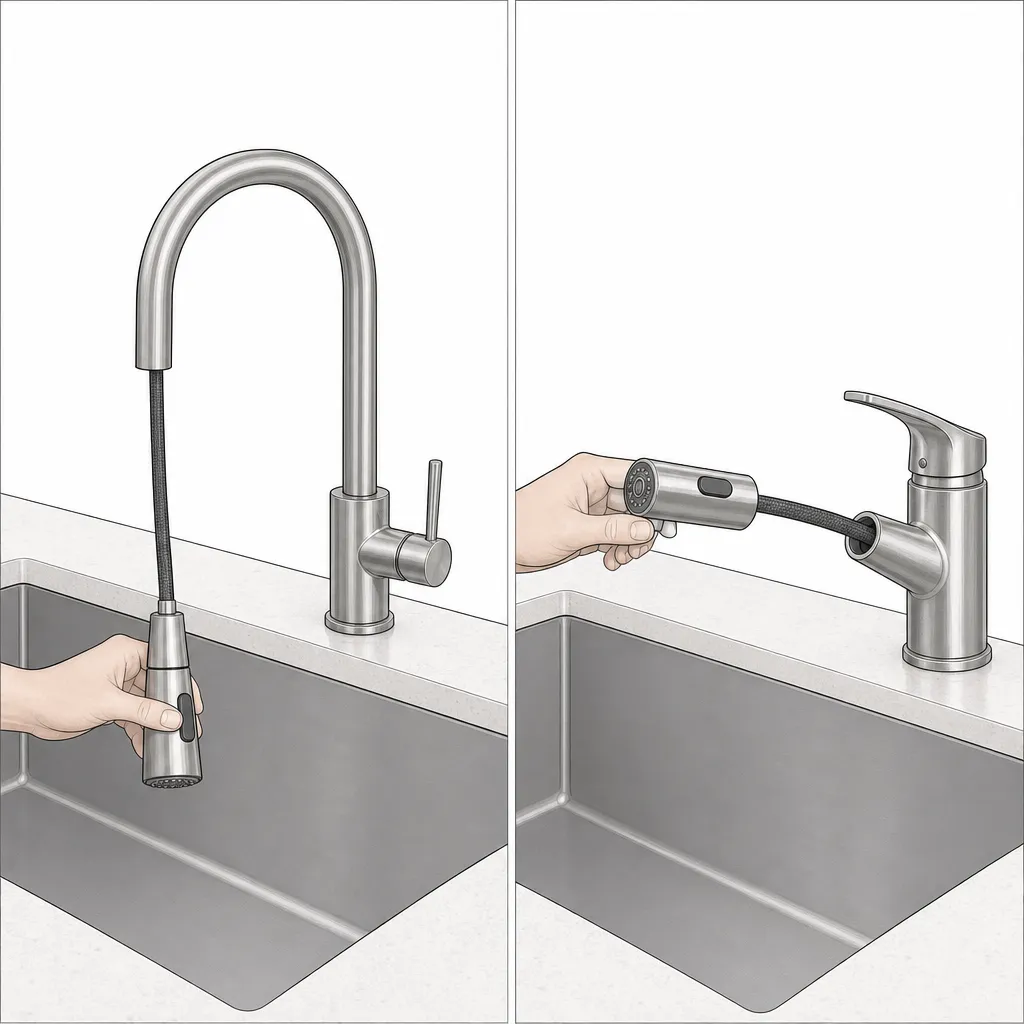
You're standing in the aisle, staring at two faucets that look almost identical, and the spec sheet isn't helping. Both have a spray head, both pull out, so what's the real difference? Let's cut through the jargon and talk about what actually changes in your daily kitchen routine.
A pull-down faucet has a tall, arched spout and the spray head pulls straight down into the sink. That high clearance makes it a champ for filling stockpots or washing bulky roasting pans. The hose usually retracts with a counterweight under the sink, and the head docks securely with a magnetic or clip system. Because the spout is fixed, you get a clean, modern look that works well in deeper sinks.
A pull-out faucet has a shorter, more compact spout and the head pulls out horizontally toward you. It's ideal if you have a shallow sink, low cabinets, or a window above the sink that would block a tall gooseneck. The spray head is often smaller and easier to maneuver for rinsing vegetables or blasting gunk off plates. The hose retracts via a spring-loaded mechanism inside the spout, so there's no dangling weight underneath.
Here's why those differences matter in practice, not just on paper. If you do a lot of heavy-duty cooking, the pull-down's height and reach save your back and your patience. If your kitchen is tight on space or you're washing delicate produce, the pull-out's compact control feels more natural. Experienced plumbers point out that pull-down hoses can snag on under-sink clutter if the counterweight isn't positioned correctly, while pull-out hoses may wear out the internal spring over time if you're rough with them.
Design Secrets: The Hose and Spring Mechanisms
The heart of every faucet lies in its hose and spring mechanisms — get this right, and you'll enjoy years of smooth, reliable use. A flexible hose sheathed in a spring distributes the pull force evenly across the base, reducing stress and extending the faucet's life. You'll feel the difference when you're rinsing a heavy stockpot or reaching every corner of the sink: the flexibility and range of motion make maneuvering water flow a breeze.
Moen's Reflex pulldown system takes this a step further, offering smoother operation, easy movement, and secure docking so the spray head stays put when you're not using it 5. If you ever find your pull-down hose stuck and it won't retract, don't panic — a small metal collar may have been pulled up into the U-shaped part of the spout. Try bending a paper clip into a small hook and see if you can pull that collar down and out 1.
When it's time to disconnect the hose for cleaning or replacement, you'll be glad to know that many pull-down and pull-out faucets use quick-connect fittings under the sink for easy removal without tools 6.
Brand Recommendations: Kohler and Moen – Trusted Excellence
Kohler and Moen have earned their stripes with working plumbers for a reason — they build faucets that hold up. Kohler is a leading manufacturer of kitchen faucets, and their buying guide walks you through the whole lineup so you can match the right model to your sink and scrubbing style 7. Their pull-downs use a simple weight system to retract the hose, which is easy to understand and fix if it ever hangs up.
Moen takes a different approach with their Reflex technology — it uses a magnetic docking system to snap the spray head back into place. You'll find advanced features like PowerBoost spray technology for blasting stuck-on food and Duralock quick-connect installation that makes swapping a faucet a one-person job 5. Both brands back their faucets with a lifetime warranty, so you're covered for the long haul.
What really seals the deal for a lot of homeowners is how Moen handles that warranty. One homeowner reported calling 1-800-465-6130 and getting a free replacement part shipped out, no hassle 1. When a company stands behind its product like that, it's a lot easier to commit to a faucet you'll use every single day.
Cost considerations
You've probably noticed that pull-down and pull-out faucets don't come with the same price tag. The difference isn't just about the name on the box — it's about what you're getting for your money. Pull-down faucets, with their tall gooseneck spouts and magnetic docking, tend to cost more upfront. You'll often pay for a heavier-duty hose, a more complex spray head, and a finish that holds up to years of yanking and spraying. Pull-out faucets, by comparison, are usually more budget-friendly. Their compact design uses less material, and the mechanism is simpler, which keeps the price down.
But the sticker price is only half the story. Working plumbers note that pull-down faucets can be pricier to repair if the hose retraction fails or the docking system wears out 1. Pull-out faucets, with fewer moving parts, often mean fewer repair bills over time. That said, a well-built pull-down from a reputable brand can last a decade or more without a hiccup, so the long-term cost might even out. One homeowner reported that Moen replaced a faulty pull-down unit under warranty with minimal hassle, which saved them a few hundred dollars 1. If you're leaning toward a pull-down, check the warranty — a lifetime limited warranty on the finish and cartridge can make the higher initial cost a safer bet.
When you're comparing prices, don't forget installation. If you're swapping out an old faucet, a pull-out might drop right into the existing hole without extra work. A pull-down's taller profile could mean adjusting the sink or cabinet, and that's where a plumber's hourly rate starts to bite.
The Final Touch: Choosing Your Faucet
Picking the right kitchen faucet means matching it to your sink size, layout, and how you actually cook and clean. If you want extra reach and a clean look, a pull-down faucet is a solid bet. Working in a tight space and need flexibility? A pull-out model fits the bill.
One more thing: many modern faucets are built to save water, with some capping flow at about 1.5 gallons per minute at 60 psi 8. It's a small detail that can trim your water bill and daily usage.
Frequently Asked Questions
Which is better for a deep sink — pull-down or pull-out?
A pull-down faucet usually wins in a deep sink. The tall gooseneck and longer hose let you fill large pots on the counter and still reach every corner of the basin. Pull-out faucets have a shorter drop and can feel cramped when you're trying to rinse a big roasting pan.
Do pull-down faucets have more drip issues?
Not inherently, but the weight of the spray head can cause the hose to sag over time if the retraction system isn't well-designed. Experienced plumbers say the most common callbacks are for hoses that won't stay docked, not for leaks at the spout 1. A quality weight or magnetic docking system makes a big difference.
Can I install either type in a rental or apartment?
Yes, both styles fit standard single-hole or three-hole sinks with a deck plate. The main constraint is clearance — pull-downs need more overhead room, so measure the distance to your upper cabinets before you buy. If you're renting, check your lease; some landlords prefer you leave plumbing changes to a pro.
What's the real-world flow-rate difference?
Most modern kitchen faucets fall in the 1.5 to 2.2 gallons-per-minute (gpm) range to meet water-efficiency standards 9. The spray head design — pull-down or pull-out — doesn't change the flow rate; the aerator and valve do. If you want a stronger stream, look for a model with a "boost" or "power rinse" mode.
How long do the hoses last?
A well-made braided hose can last 10–15 years under normal use. The weak point is usually the connection at the spray head, not the hose itself. If yours fails sooner, check the warranty before you buy a replacement — major brands cover the hose, so a fix may cost you nothing but a phone call. Keep your proof of purchase.