
A Moen kitchen faucet that won't shut off isn't a mystery — it's almost always one worn part doing the same thing it does on every brand: the cartridge has given up. The good news is that Moen makes this one of the easier repairs on any faucet, and if your tap is out of warranty paperwork but still attached to a U.S. household, Moen will usually ship a free cartridge anyway.
This guide walks through the three things that actually matter: which cartridge you have (it's one of three, not dozens), what the wear pattern tells you before you order parts, and how to get the cartridge out — including what to do when it's cemented in place by years of hard water.
- Why a Moen faucet keeps running after you close the handle
- Identify your cartridge: 1225 vs 1255 Duralast vs 1200-series
- Read the wear pattern before you order parts
- Check warranty first — Moen ships free cartridges
- Replace a 1255 Duralast cartridge (post-2009 faucets)
- Replace a 1225 cartridge (pre-2009 faucets, including stuck ones)
- When it's not the cartridge: O-rings, valve seat, aerator
- When to call a plumber
- Where to buy replacement cartridges
Why a Moen faucet keeps running after you close the handle
Every single-handle Moen kitchen faucet hides the same mechanism: a cartridge with internal seals that press against a polished seat when you rotate the handle shut. When those seals lose their spring, chip, or pick up mineral buildup, they stop making a clean seal — so water keeps slipping past, even with the handle all the way off.
If you have a two-handle faucet instead, the same logic applies to each side. A dripping hot side means the hot cartridge is worn; a dripping cold side means the cold one is. They wear at different rates because hot-side rubber degrades faster.
Cartridges are wear parts. The first one usually lasts 8–15 years on municipal water; in a hard-water household you might get half that. It's the part Moen designed to be replaced.
Identify your cartridge: 1225 vs 1255 Duralast vs 1200-series
Before you touch a wrench, figure out which cartridge you're dealing with. This one step saves most of the trouble people run into on this repair.
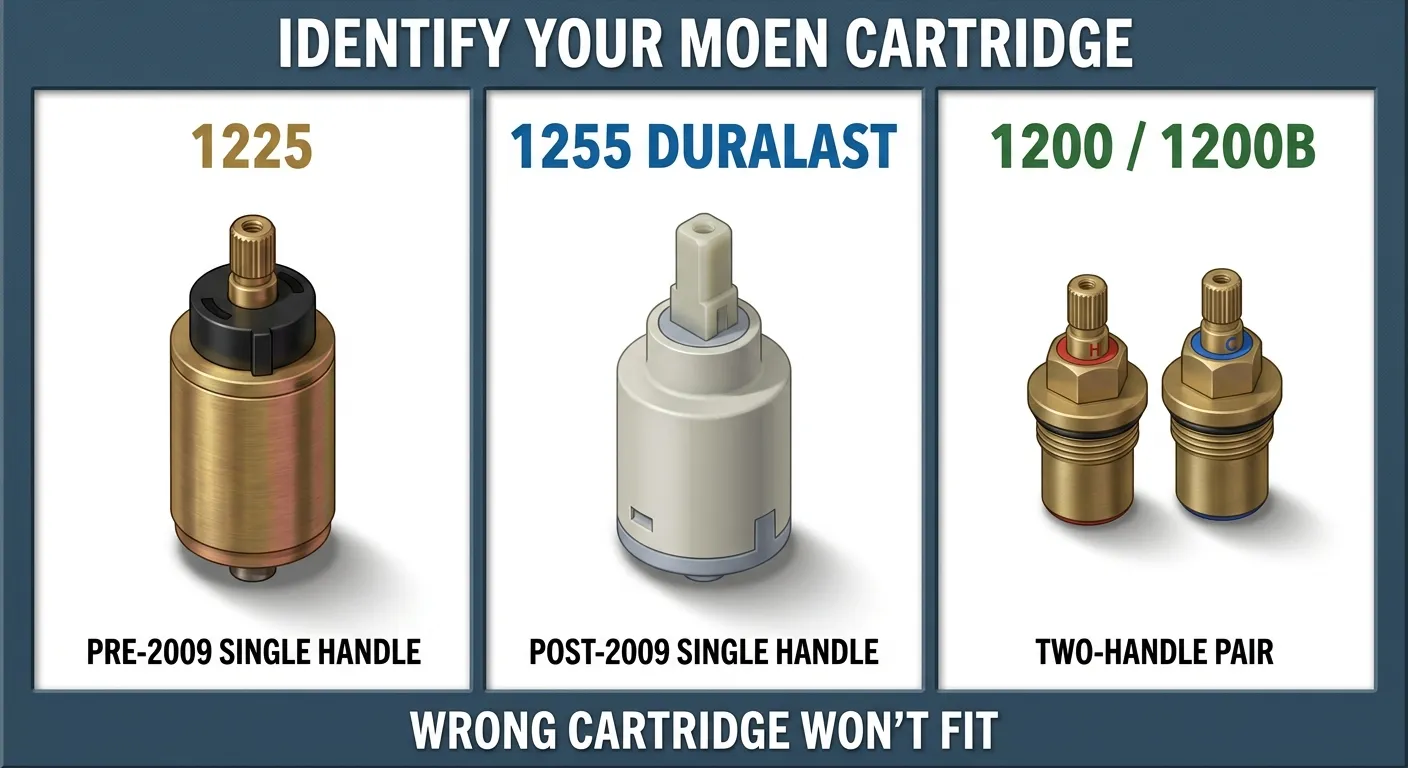
| Cartridge | Faucet era | Faucet style | What it looks like |
|---|---|---|---|
| 1225 / 1225B1 | Pre-2009 | Single-handle kitchen and bathroom | Brass body, black plastic cap, about 4" long. Heavier than it looks. |
| 1255 Duralast2 | ~2009 and newer | Single-handle kitchen (most current models) | One-piece white/grey polymer body, lighter, no separate brass shell. |
| 1200 / 1200B3 | All eras | Two-handle kitchen and bathroom (pair) | Smaller cartridge; you'll have two, one per handle. |
A few fast ways to narrow it down without disassembling anything:
- Age of the faucet. If it was installed new after 2009 and is a single-handle kitchen faucet, it's almost certainly a 1255 Duralast.
- Handle feel. The 1255 has a noticeably smoother, lighter handle throw than the older 1225. If yours feels gritty and stiff, it's likely a 1225 that's full of scale.
- Model number on the faucet. Flip the handle back or look under the spout base for a four-digit model number (e.g., 7594, 87999). Drop that into Moen's parts lookup and it'll name the cartridge outright.
- The cartridge itself is stamped. If you've already pulled it, the number is molded into the plastic cap or laser-etched into the brass.
Ordering the wrong cartridge is the single most common mistake on this repair — a 1255 will not drop into a 1225 cavity, and the other way around. Confirm before you buy.
Read the wear pattern before you order parts
Once the cartridge is out, spend thirty seconds looking at it before you bin it. The failure mode tells you whether the cartridge alone is the fix or whether something else in the valve body needs attention.
Flat spots on the rubber seals. The most common finding. The O-rings and the disc seals have compressed into oval shapes and lost their sealing pressure. Replace the cartridge; the valve body is fine.
Green or white crust on the brass (1225 only). Hard-water scale has built up in the annular grooves where the O-rings ride. New cartridge will seal, but the scale will chew up the next set of seals faster. Run a vinegar soak through the valve body before the new cartridge goes in, and consider a whole-house softener if you're on well water.
Cracked polymer shell (1255 only). The one-piece Duralast body has split — usually at the top cap where the stem passes through. This happens on faucets that were over-torqued during earlier service. New cartridge fixes it; no damage to the faucet body.
Shiny scored ring on the cartridge body. A sharp particle — usually a piece of pipe scale that came through at install — has scratched the sealing surface. Cartridge replacement is enough, but install an inline screen or shut off, pull the cartridge, and flush the supply lines before reassembly.
Pitted valve seat inside the faucet body. Look down into the cavity after you've pulled the cartridge. If the machined surface the cartridge seals against shows pits or corrosion, a new cartridge alone won't hold. This is the one situation where the repair gets harder — see the valve-seat section below.
Check warranty first — Moen ships free cartridges
Moen's residential faucets carry a Limited Lifetime Warranty that covers leaks and drips for as long as the original purchaser owns the home.4 In practice, Moen's customer service desk is famously generous about honoring this — a phone call usually gets a replacement cartridge in the mail within a week, no receipt required, and no questions about who bought the faucet.
Before you drive to a home improvement store, call 1-800-BUY-MOEN (1-800-289-6636), tell them the faucet model number and that you have a drip. They'll ship the correct cartridge at no charge.5 You can also file the same request online at moen.com under Customer Support → Request a Part.
If you need the cartridge today, working plumbers report that several big-box hardware stores also keep a warranty stash of common Moen cartridges behind the returns counter — bring the faucet model number (or the old cartridge) and ask for a warranty exchange. It's the same free-replacement process, just in person.6
This is the single highest-ROI step on this entire repair, and it's the step most guides skip.
Replace a 1255 Duralast cartridge (post-2009 faucets)
The 1255 is the easier of the two — no special puller, no stuck brass, just a clean lift-out. You'll need a 7/64" hex (Allen) key for the handle set screw, an adjustable wrench for the retainer nut, and safety glasses.
1. Shut off the water and relieve pressure.
Close both angle stops under the sink (quarter-turn handles — clockwise to close). If they won't fully close — common on old stops — use the main house shutoff instead. Open the faucet handle to drain line pressure.
2. Pull the handle.
Pop off the decorative cap on the handle (most flip off with a fingernail or a trim pick). Loosen the set screw underneath with the 7/64" hex; don't back it all the way out. Lift the handle straight up.
3. Remove the dome and retainer nut.
The dome is the metal cover that sits over the cartridge. It unscrews by hand on most 1255 faucets. Underneath it is a plastic retainer nut — unthread it with the adjustable wrench. It's hand-tight plus a wrench snug, nothing dramatic.
4. Lift the cartridge straight out.
On a healthy 1255, the cartridge comes out with light finger pressure. Note the orientation before it leaves the cavity — the hot-side tab faces a specific direction, and you'll set the new one the same way. If the faucet comes out rotated, you'll get reversed hot and cold.
5. Inspect and clean.
Wipe the inside of the valve body with a rag. If you see mineral buildup, a 50/50 vinegar-water soak on a paper towel laid inside the cavity for 15 minutes dissolves it. Don't use abrasives; the sealing surface is softer than it looks.
6. Drop in the new cartridge.
Align the tab the same way the old one came out. It seats with light pressure — no pounding, no pliers. Thread the retainer nut back on hand-tight, then snug it with the wrench; overtightening cracks the polymer.
Before the cartridge goes in, experienced plumbers put a thin film of plumber-grade silicone grease (not petroleum jelly — it swells the seals) on the O-rings. It's a 30-second step that measurably extends cartridge life and, more importantly, stops the next cartridge from fusing to the cavity.12
7. Reinstall the dome and handle, turn the water back on.
Reattach in reverse order, tighten the set screw, and open the angle stops slowly. Run the faucet on hot and cold through a full cycle before calling it done.
Replace a 1225 cartridge (pre-2009 faucets, including stuck ones)
The 1225 is the same job in concept, but a cartridge that's been sitting in hard water for ten years can fuse to the brass cavity. Plan for that before you start.
Tools you actually need: 7/64" or 3/32" hex key, adjustable wrench, channel-lock pliers, and — this is the one most people are missing — the Moen 104421 cartridge puller.8 It's a small threaded tool designed specifically for extracting stuck 1225s. Home improvement stores stock it for roughly $15, and on a seized cartridge it's the difference between a 30-minute job and breaking the faucet.
Steps 1 through 3 are the same as the 1255 above. Where it diverges:
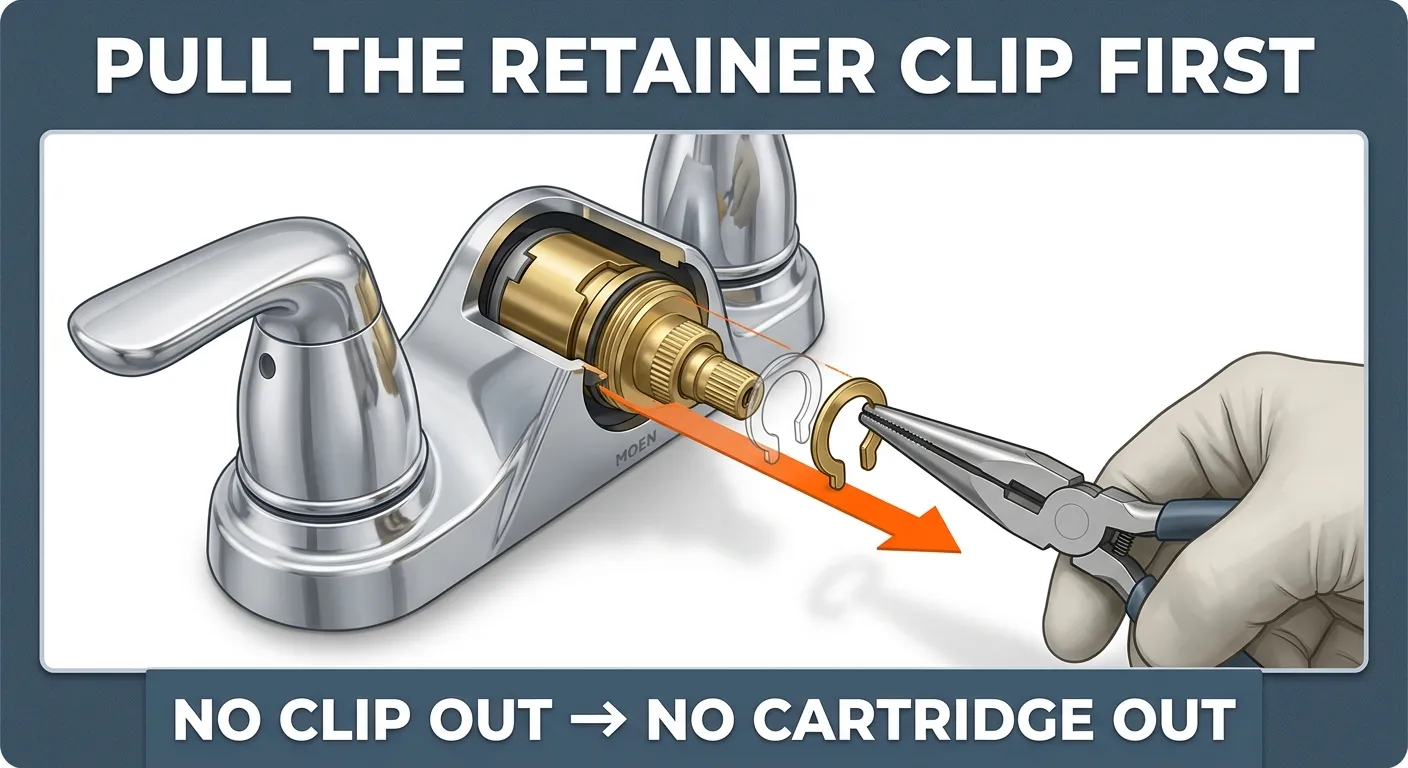
4a. Remove the retainer clip — this is the step everyone misses.
The 1225 is held in place by a small horseshoe-shaped brass clip that slides in sideways through the valve body. Working plumbers' number-one rule on this repair is pull the clip first — nothing else matters until it's out, and no amount of heaving will move the cartridge while the clip is seated.7 Pull the chrome sleeve off to expose it, pry it out with a flathead or needle-nose pliers, and set it somewhere you won't lose it — the new cartridge usually doesn't ship with one.
4b. Twist the stem to break it free.
With channel-lock pliers on the top stem, rotate the cartridge a quarter-turn in each direction. This breaks the seal between the O-rings and the brass cavity and is the step that prevents the cartridge-puller drama below. Sometimes that's enough and you can lift it straight out.
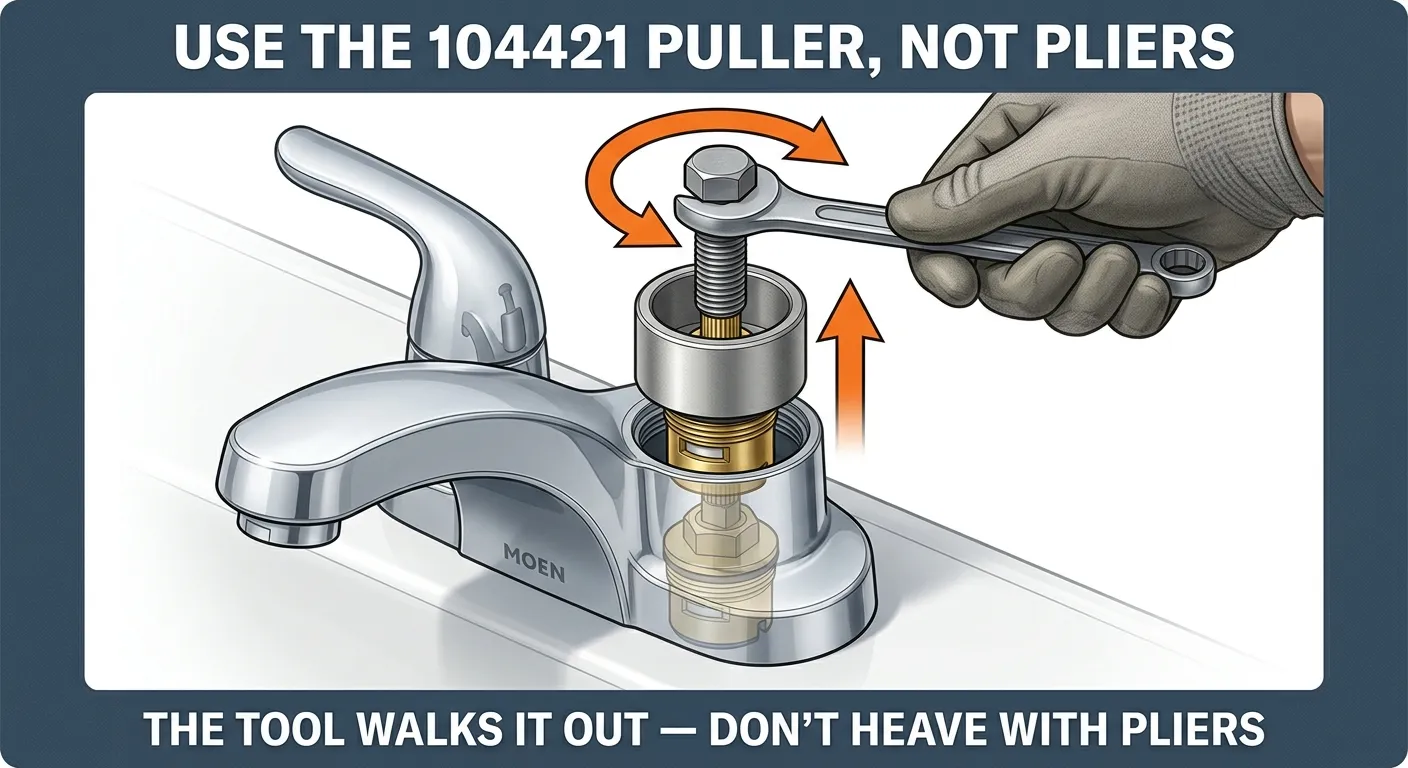
4c. If it won't budge, use the 104421 puller.
Thread the puller down onto the cartridge stem, back off the outer sleeve until it bottoms against the valve body, then turn the top bolt clockwise. The cartridge walks up out of the cavity as you turn. Don't heave on it with pliers — you'll tear the stem off and leave the body stuck, which is the classic "now I need a plumber" failure on this repair.
4d. If heat is needed — a technique working plumbers use.
When a 1225 has been in hard water for 15+ years, the puller alone sometimes can't break it loose. Experienced plumbers briefly warm the brass valve body with a small propane torch — two to three seconds, just enough to soften the rubber O-rings — and the cartridge lifts out on the next pull.9 Keep the flame moving, keep it well away from any plastic trim and the supply hoses, and don't do this on the 1255's polymer body. If you're not comfortable with a torch near the plumbing, skip this step and move on.
4e. If the stem snaps off flush with the body.
This happens. A stem that's been gripped hard with pliers or pulled against a stuck retainer clip will tear off and leave the body stuck in the cavity. You have two recoveries working plumbers use:
- Drill and easy-out. Center-drill a 1/4" pilot hole down the old stem, back-tap with a screw extractor, and use the extractor's grip to pull the remaining cartridge up. This usually fractures the plastic cap, which you then clear with needle-nose pliers.10
- Break it out in pieces. If the body won't come out whole, plumbers will deliberately fragment it with a flathead screwdriver and small pick, pulling the brass-and-plastic debris out piece by piece, then flushing the cavity with water before installing the new cartridge.11 This isn't the clean outcome, but it's recoverable — and a faucet body that came out in pieces is still a faucet body that takes a new cartridge.
If both of those feel outside your comfort zone, this is a fair point to stop and bring in a plumber. Calling it at "stem snapped, cavity stuck" costs less than calling it at "I've now gouged the brass seat."
5. Clean the cavity thoroughly.
Hard-water scale in a 1225 cavity is non-trivial. Scrub with a nylon bottle brush and a vinegar soak; a clean cavity is what makes the new cartridge last.
6. Install the new cartridge and retainer clip.
Align the flats on the stem with the position shown on the Moen instruction sheet (usually the small ear points forward). A thin film of plumber-grade silicone grease on the O-rings before the cartridge goes in is the same prevention trick from the 1255 section — it's what keeps the next homeowner out of the heat-and-easy-out section above. Slide the retainer clip all the way in — it should click flush. If the clip doesn't seat, the cartridge isn't fully down; press it in and try again.
The rest is the 1255 procedure in reverse.
When it's not the cartridge: O-rings, valve seat, aerator
If you replaced the cartridge and the faucet still drips — or if the drip is coming from the base of the spout rather than the tip — the cartridge wasn't your problem. A few other suspects:
Spout base O-rings. On pull-out and pull-down kitchen faucets, the spout rotates on a pair of O-rings at its base. When those wear, you get water creeping out around the base of the spout (often mistaken for a countertop leak). Moen sells the O-ring kit for a few dollars. Disassembly is similar to the cartridge job — handle off, spout lifts off — and the O-rings roll off the column.
A pitted valve seat. If you see visible pitting on the machined seating surface after pulling the cartridge, a new cartridge won't hold against it. On some Moen models the seat is a serviceable part; on others it's integral to the faucet body, which means either a Moen warranty replacement of the whole faucet or a full faucet swap. Call Moen before you do anything else here — this is exactly the scenario their warranty was designed for.
A clogged aerator. This doesn't cause a drip, but it causes the symptom people confuse with a drip: a faucet that still runs a trickle after you close the handle. If water runs from the spout tip at low flow with the handle closed, it's actually surface tension on a dirty aerator — unscrew it, soak in vinegar, reinstall.
A failed diverter (pull-out faucets). If water comes out of the sprayer when you've switched to the spout, or vice versa, the diverter — not the cartridge — is the problem. Diverters are a separate service part and a different repair.
When to call a plumber
Most Moen drips are a cartridge swap a homeowner can do in an hour. Bring in a licensed plumber when:
- The valve seat inside the faucet body is pitted or damaged, and Moen's response is "replace the faucet."
- The cartridge snaps during extraction and the stem breaks off below the valve body.
- The angle stops under the sink won't close fully, so you can't safely isolate water to the faucet.
- You have a slab leak or any sign of water inside the cabinet base (swollen particle board, mildew), which is a separate problem from the faucet drip.
- The faucet is older than 20 years and parts are discontinued — at that point a new faucet is usually cheaper than the labor to chase down service parts.
Where to buy replacement cartridges
Start with Moen — call 1-800-BUY-MOEN or file a parts request at moen.com. If warranty doesn't apply (rental properties, commercial use, non-original owner) or you need it today, the 1225, 1255, and 1200-series cartridges — the parts themselves — are the same everywhere. One thing to know about whole-faucet purchases, not parts: working plumbers point out that some Moen faucets sold at the big-box retailers are a lower-spec line than what a plumbing supply house carries, and the model numbers are different. For a cartridge you can buy anywhere; for a replacement faucet, it's worth asking a local supply house what they stock.6
Cartridges are stocked at:
- The Home Depot — usually in the plumbing aisle, boxed by cartridge number.
- Lowe's — same.
- Ace Hardware — surprisingly strong on Moen service parts.
- Menards — in the Midwest.
- Ferguson / Build.com — better for less common models.
- Amazon — fastest if you're certain of the cartridge number. Watch out for aftermarket copies; stick to "sold by Moen" or "sold by Amazon" for the genuine part.
- faucet.com / FaucetDirect.com — useful for full-faucet replacements if you end up there.
When you order, you need two things: the cartridge number (1225, 1255, 1200, etc.) and, ideally, the faucet model number stamped on the underside. With both, you can't order the wrong thing.
About the author. This article was written and reviewed by Eng. Thilina Rathnayaka, a water-supply engineer with a BSc in Civil Engineering from the University of Moratuwa and ten-plus years designing water distribution and leak-detection programs under ADB, World Bank, UNDP, and JICA. Guidance on residential faucet service parts is cross-checked against Moen's published service documentation and cartridge installation sheets. For repairs that fall outside manufacturer documentation — such as a damaged valve body or a pressurized leak behind a cabinet — we recommend a locally licensed plumber.