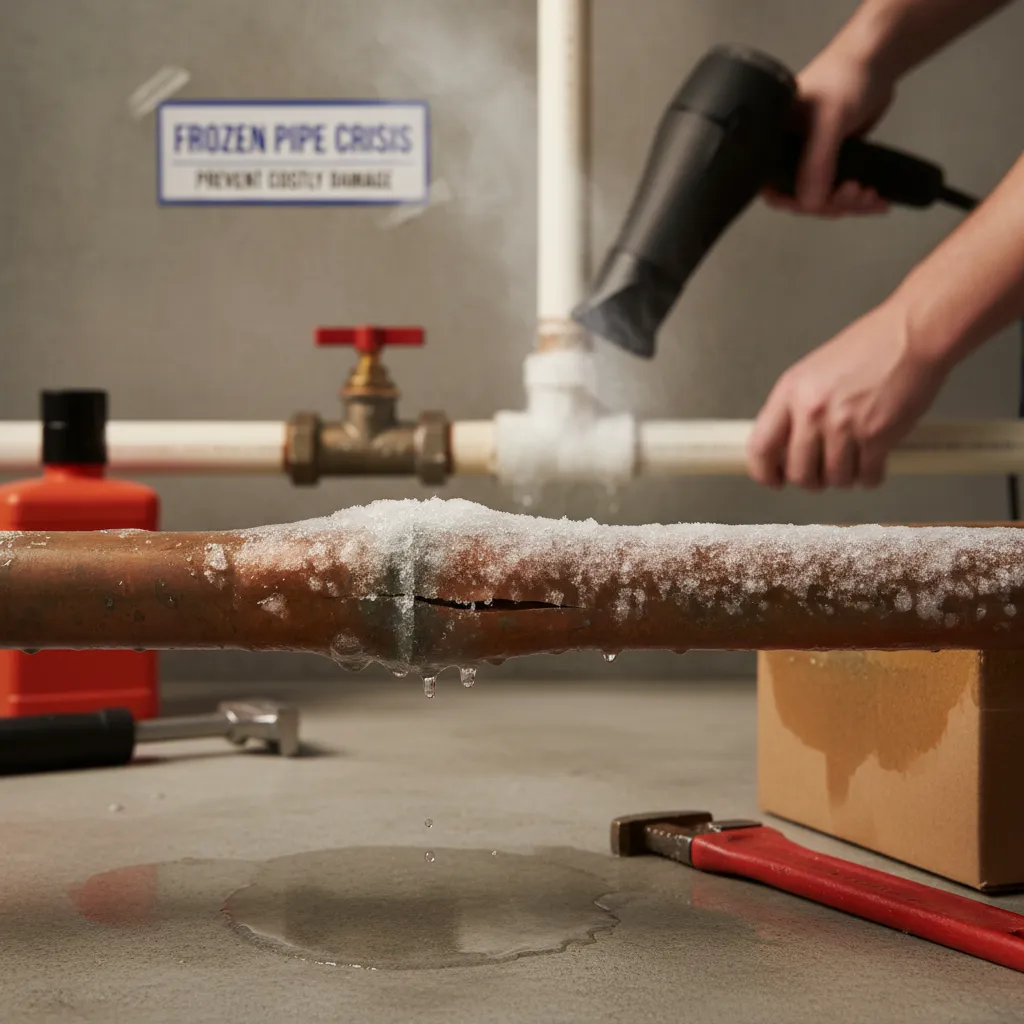
Waking up to no water on a freezing morning is more than inconvenient — it's a race against the clock. That icy blockage is already putting pressure on the pipe wall, and the longer it sits, the higher the burst risk climbs. The good news: the first moves are simple, and you can do them yourself without special tools.
This guide covers the two jobs that matter: thaw the pipe without causing a burst, and keep it from happening again with the right insulation and heat cable for your climate. The advice here is built from what experienced plumbers actually tell homeowners — not the generic blog version.
Tools Needed
- Hair dryer (1500W class — it's the tool plumbers actually recommend for DIY thaw)
- Heat lamp or UL-listed ceramic space heater with tip-over and overheat shutoff
- Infrared thermometer ($20–50) to find the freeze and watch the thaw
- Closed-cell foam pipe insulation (1/2"–1" wall, sized to pipe OD)
- Towels and rags (hold heat on the pipe; catch drips)
Materials Needed
- Electrical tape (temporary seam only — never on a leak or a heater)
- UL-listed self-regulating pipe heat cable, thermostatically controlled
- Closed-cell foam sleeves for permanent insulation
- 5-gallon bucket for thaw drips and possible joint weeps
Solution (Beginner — thaw time 1–12 hours depending on severity)
Step 1: Shut off water and find the freeze.
Close your main shutoff (turn clockwise). It's usually at the meter or where the service enters the house. Open the affected faucets — this relieves pressure and gives melting water somewhere to go. Then walk the line feeling for very cold sections. An IR thermometer makes this trivial: the frozen section will read 10–25°F colder than adjacent pipe.
Common freeze points, in the order you should check them:
- Cabinets on an exterior wall (not interior cabinets — the outside-wall ones are what actually freeze)1
- Crawl spaces and rim joists
- Attic runs over garages and porches
- Uninsulated copper or PEX near hose bibs
- Garage supply lines
⚠️ Do not skip the shutoff. Thawing a frozen section that's still pressurized is how a slow burst becomes an active flood.
Step 2: Apply gentle heat from the faucet toward the freeze.
Start at the faucet end and work back toward the ice plug. Heat in the middle of an ice plug has nowhere to vent — pressure builds, and the pipe bulges or ruptures.
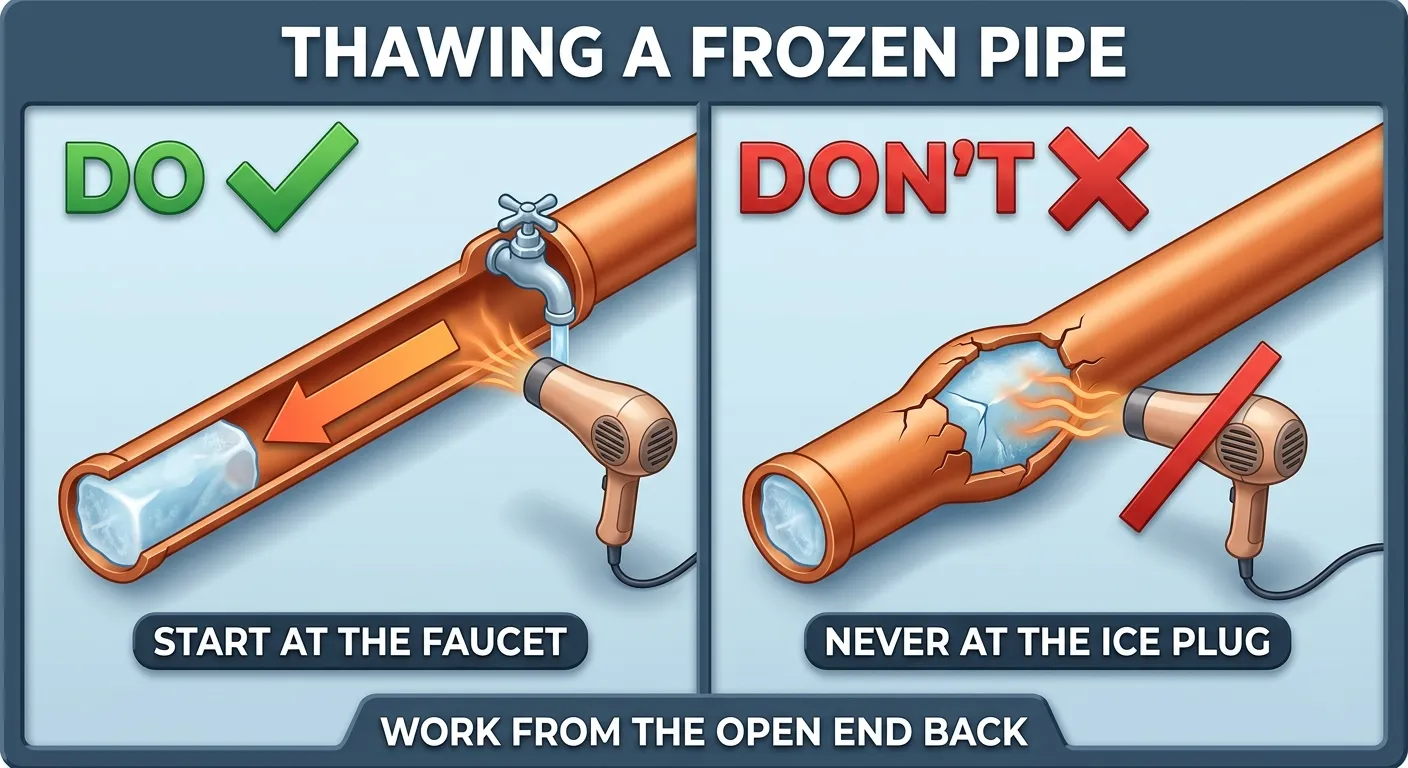
- Primary tool: 1500W hair dryer on medium, waved along the pipe. One homeowner who followed this plumber-recommended method reported about two inches of ice came out of the spigot — and no burst.2
- For enclosed spots: UL-listed ceramic heater or 250W heat lamp, 12 inches minimum from the pipe and any combustible.
- Wrap heated sections with a dry towel to hold heat on the pipe.
⚠️ No open flames. No propane torch, no MAPP gas, no kerosene heater pointed at a pipe. Torch-thawing copper pipe in an enclosed space is a line item in plumber incident reports every winter.
Step 3: Wait for flow, then re-pressurize slowly.
Here's the part most guides lie about. A severely frozen section can take 6–12 hours to fully flow even with heat applied the whole time. Water starts trickling when the pipe surface gets past ~35°F, and volume builds gradually from there. If you've been at it 30 minutes and nothing is coming out, that's normal — keep heat on it.
Once full flow returns:
- Close all faucets.
- Slowly reopen the main valve (don't snap it open — pressure surge can finish off a pipe that was already stressed).
- Walk every joint, shutoff, and fixture connection within the thawed run. Look for weeps, bulges, or fresh white corrosion rings.
- Listen with the faucets closed — running-water noise with nothing open means a hidden leak.
⚠️ If you see a bulge, a spray, or a split: shut the main again and call a licensed plumber. Temporary SharkBite or epoxy-putty repairs exist, but a burst on a pressurized line needs to be isolated and replaced, not patched.
Step 4: Insulate before the next cold night.
A pipe that froze once will freeze again at the same spot — the failure cause (cold-side air leak, missing insulation, no heat cable) is still there. Before dark:
- Wrap the run with closed-cell foam pipe insulation, sealed seams.
- If the pipe is in unconditioned space, add self-regulating heat cable (sizing table below).
- Seal air leaks behind the pipe (the cold-air path, not the pipe itself) with canned foam or caulk. This is what actually prevents recurrence.
Heat cable sizing by pipe and climate
Self-regulating heat cable varies output with pipe temperature — it draws more when the pipe is cold, less when it's warm. This is the only type you should use on plastic pipe. Typical sizing at 50°F pipe temp:
| Pipe size (copper/PEX) | Minimum cable wattage | Typical product class |
|---|---|---|
| 1/2" | 3 W/ft | 3-watt self-regulating |
| 3/4" | 5 W/ft | 5-watt self-regulating |
| 1" | 5–7 W/ft | 5- or 7-watt self-regulating |
| 1-1/4" and up | 7–9 W/ft | 7- or 9-watt, often 2 runs on same pipe |
Go one step up if the pipe is in an attic, vented crawl, or anywhere the air temperature is regularly below 20°F. Always confirm the cable is UL listed to UL 515 and use the manufacturer's thermostat — a thermostatic head is not optional on plastic pipe.3
Foam insulation thickness: what plumbers actually install
Plumbing codes (IRC P2603.5,4 UPC 312.68) require that pipes in spaces subject to freezing — exterior walls, attics, vented crawl spaces, unheated garages — be protected by insulation, heat, or both. Neither code prescribes a thickness or R-value; that's left to the installer. Here's what experienced plumbers typically put on supply lines, by climate:
| Climate zone | Typical install | Approx. R-value |
|---|---|---|
| Zones 1–3 (south) | 1/2" closed-cell foam | R-2 to R-2.5 |
| Zones 4–5 | 3/4" closed-cell foam | R-3 |
| Zones 6–7 (cold) | 1" closed-cell foam, or foam + fiberglass over pipe | R-4+ |
| Zone 8 (subarctic) | 1" closed-cell + heat cable + sealed chase | R-4+ |
Foam thickness alone doesn't stop a freeze in a very cold or windy location — insulation slows heat loss, it doesn't add heat. Once outdoor temps drop well below 20°F on an unheated run, pair the foam with heat cable and seal the air leaks behind the pipe.
When the heat goes out: shut off and drain
This is the scenario most guides skip, and it's one of the most common causes of winter pipe failures.5 If you're going to lose heat for more than a few hours — planned outage, power cut, or traveling — don't trust a dripping faucet to save the pipes.
- Shut off the water heater first. Gas: set to pilot or off. Electric: flip the breaker. Running an electric element dry will destroy it.
- Close the main water valve.
- Open the lowest faucet in the house and a faucet on every floor above.
- Open the water heater drain (only after confirming power/gas is off).
- Flush toilets until the tank empties; add a cup of RV antifreeze to each bowl to keep the trap from freezing solid.
⚠️ Galvanized-pipe caveat: If your supply lines are old galvanized steel, draining and re-pressurizing can shake loose decades of rust and clog every aerator, cartridge, and angle stop in the house.6 Experienced plumbers routinely recommend not fully draining galvanized systems unless the freeze risk is unavoidable.
PEX vs copper: it matters during a freeze
Both can burst, but they fail differently:
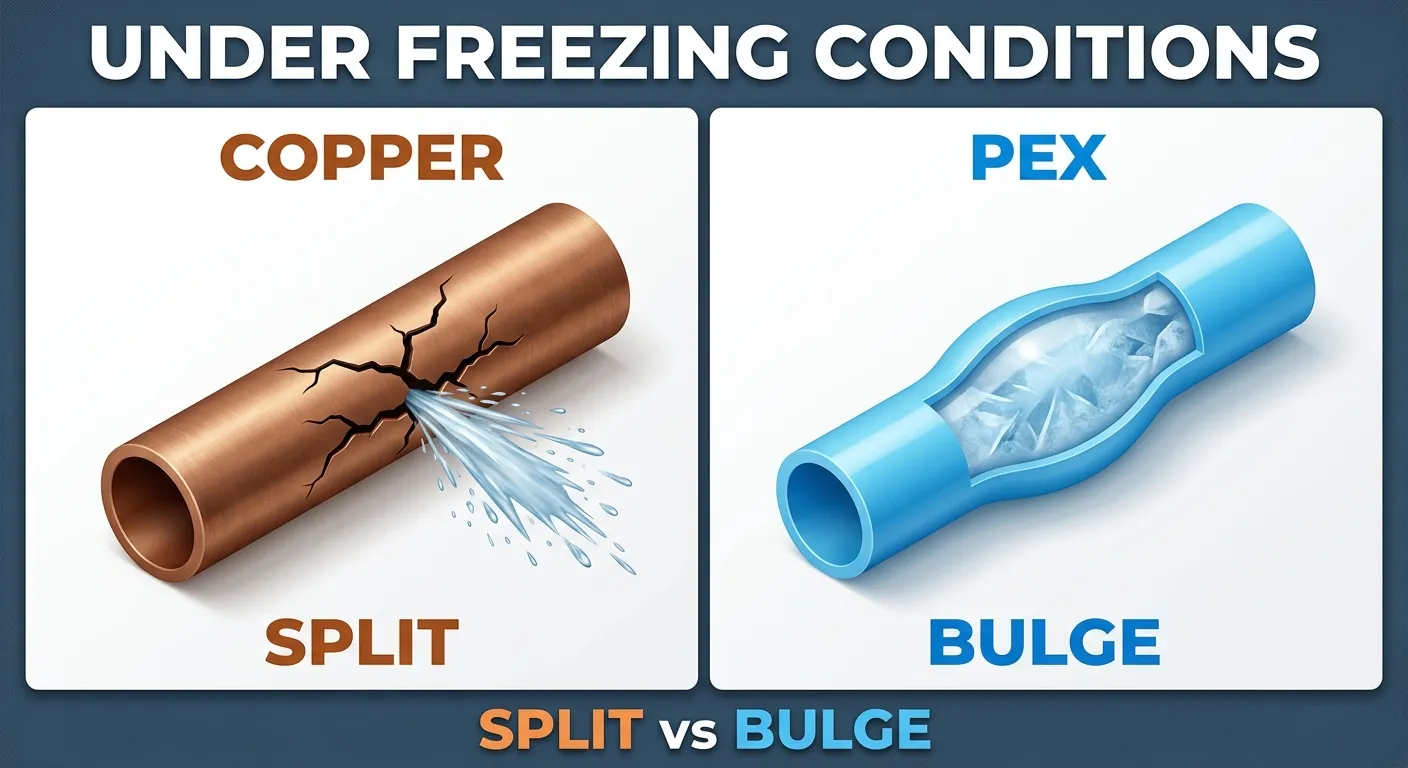
- Copper fails catastrophically — a clean longitudinal split, often spraying water at full line pressure. Common at solder joints and elbows.
- PEX can tolerate some expansion because the tubing stretches, but "freeze resistant" is not "freeze proof." Extended freezing, or a freeze at a brass or copper fitting, will still rupture PEX. Drain it.
- CPVC is the worst of both — brittle at cold temperatures, cracks easily under freeze expansion.
If you're re-piping a run through an unconditioned attic or crawl, PEX with sealed-foam insulation and heat cable is the current best-practice combination working plumbers recommend.7
Pro tips
- Pencil-thick trickle beats "slow drip." A real stream of moving water resists freezing; a drip does not meaningfully help. Pencil-lead thickness is the rule of thumb experienced plumbers give homeowners.1
- Open exterior-wall cabinets only. Opening interior cabinets just cools your house for no reason. It's the exterior-wall cabinets that act as thermal dams.
- Block wind, not just cold. On mobile homes and pier-and-beam foundations, skirting and under-structure wind blockers matter more than adding insulation to already-insulated runs.
- Thaw metal before plastic on mixed systems. Copper conducts heat faster, so it'll give up the ice first and restart flow sooner.
When to call a professional
Call a licensed plumber immediately if:
- You see a burst, spraying, or bulging pipe.
- The frozen section is behind a finished wall or under a slab.
- No water returns after 8+ hours of proper thawing with heat applied continuously.
- You smell sewage — a frozen drain or main-line freeze is a different, harder problem.
- You have a finished basement, active water in contact with drywall, or electrical panels near the wet area.
Thermal cameras (which most service plumbers carry) can locate a freeze inside a wall in minutes without cutting drywall — worth the call-out fee.
Understanding the Problem in Detail
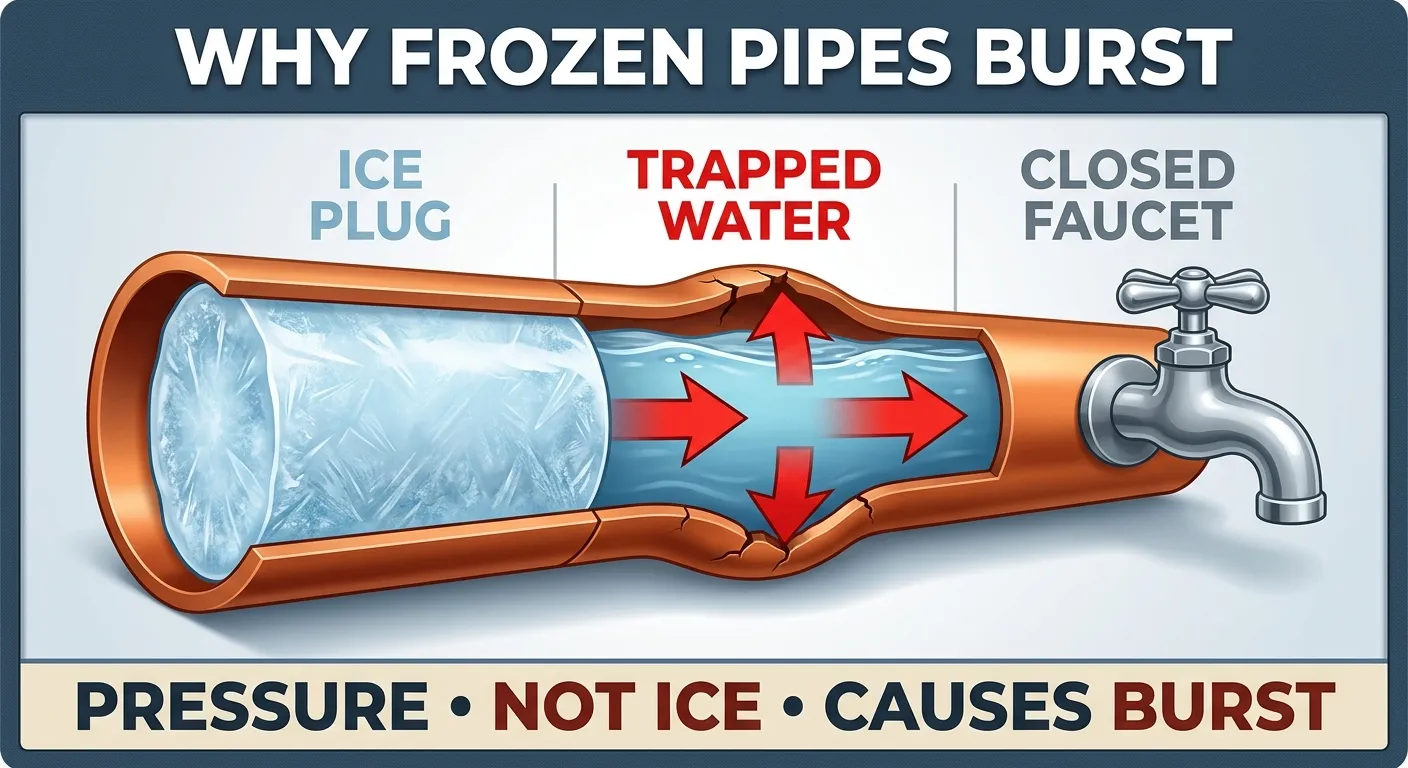
Water expands roughly 9% when it freezes. In a pressurized closed system (your house), the expansion has nowhere to go, and pressure inside the pipe spikes — lab tests have measured over 40,000 PSI at the ice-water interface before the pipe yields. What actually bursts is almost never the ice plug itself; it's the trapped liquid water between the ice plug and a closed fixture, which is why opening the faucet during thaw is non-negotiable.
Pipes freeze fastest where:
- Cold air reaches the outside of the pipe (exterior-wall cavities with air leaks, vented crawl spaces).
- Water sits stagnant (infrequently used fixtures, vacation homes).
- Metallurgy conducts cold through a penetration (a copper line running through a framing plate that crosses the exterior sheathing).
Tools and Materials Guide
Hair dryers are effective because they deliver ~1500W of diffuse, low-risk heat — enough to soften an ice plug without superheating the pipe. Heat lamps (250W) are the safer pick for enclosed spaces (less fire risk than a forced-air heater). IR thermometers ($20–50) replace guesswork with a number; cheap models from Klein, Etekcity, and Fluke all read well enough for this. For insulation, closed-cell foam outperforms open-cell at the same wall thickness and doesn't absorb condensation the way fiberglass does. Heat cable must be thermostatically controlled self-regulating — UL 515 listed — and you must follow the manufacturer's maximum-length and thermostat rules.
Safety Considerations
- Electrocution: keep hair dryers, heaters, and IR thermometers away from active water. Plug into GFCI outlets only. If water is visibly pooling, kill the circuit at the panel first.
- Fire: 3 ft minimum clearance between any heater and combustibles. No unattended heat sources. Space heaters should be UL-listed with both tip-over and overheat shutoff.
- Water damage: bucket under any joint you're heating. Even a successful thaw often reveals a previously-weeping joint.
- Structural: don't cut into a finished wall blind. If the freeze is behind drywall, a plumber with a thermal imager will find it faster and cheaper than exploratory demo.
Troubleshooting Common Issues
- Pipe won't thaw after an hour: you may not be on the frozen section. IR-thermometer sweep the run again — the freeze can be several feet from the faucet.
- Flow returns, then stops again: a second ice plug further upstream is thawing into the one you cleared. Keep heat moving along the pipe.
- Minor joint leak after thaw: a compression or ferrule joint can sometimes be snugged up 1/8 turn with a wrench. Do not overtighten sweated (soldered) joints — any movement means the joint failed and needs to be redone.
- Low pressure post-thaw: sediment has migrated to aerators and cartridges. Unscrew and clean every aerator; on galvanized systems expect to pull and clean angle-stop strainers as well.
Maintenance and Prevention
Permanent fixes ranked by cost-effectiveness:
- Air-seal the pipe chase. Canned foam where pipes pass through top plates, bottom plates, and exterior sheathing. Biggest win per dollar.
- Insulate every pipe in unconditioned space with closed-cell foam to at least R-3.
- Add self-regulating heat cable on any line in attic/crawl/garage, sized per the table above.
- Hold the thermostat at a consistent setpoint — don't drop to 55°F overnight during an extreme cold snap.
- Winterize outdoor faucets (hose off, shutoff closed, drain opened) before the first freeze.
Cost Analysis: DIY vs Professional
- DIY prevention: foam sleeves $0.50–$2/ft; self-regulating heat cable $5–$10/ft installed; canned foam $8/can. Typical whole-house retrofit for an at-risk home: $150–$400 in materials.
- Professional thaw: $150–$500 depending on access; more with after-hours rates.
- Burst pipe repair alone: $500–$4,000.
- Water damage remediation after a burst: $5,000–$50,000 depending on contents and drywall area.
The asymmetry here is the entire argument for prevention: a weekend of foam and heat cable avoids an insurance claim.
Related Plumbing Problems
- Burst pipe: main off, power off if water is near fixtures, call a plumber.
- Frozen outdoor faucets: insulated covers and frost-proof sillcocks.
- Frozen drain lines: warm water poured slowly, or a drain-line heat trace for chronic cases.
- Post-thaw mold: dry cavities within 48 hours; a moisture meter is worth the $30.
Frequently Asked Questions
Can I use a blowtorch to thaw pipes faster?
No. Open flames can superheat copper, cause steam flash-offs inside the pipe, ignite framing or stored items, and are a top cause of winter house fires linked to plumbing work. Hair dryer or heat lamp only.
How long should thawing actually take?
On a light freeze (a short section, accessible pipe): 20–60 minutes. On a severe freeze where a long unconditioned run is fully solid: 6–12 hours of continuously applied heat before you see normal flow. If you're not sure which you have, plan for the longer one.
What if I can't find the frozen section?
Start at the most exposed point (hose bib, exterior-wall cabinet, attic run) and IR-thermometer your way back toward the main. If the pipe disappears into a wall and you can't find it, that's the call for a plumber with a thermal camera — cheaper than exploratory drywall demo.
Will pipes always burst when frozen?
No, but the longer they stay frozen and pressurized, the higher the risk. PEX tolerates some expansion; copper and CPVC do not. The shutoff-and-open-faucet step is what buys you time — it converts a closed pressurized freeze (high burst risk) into an open one (low burst risk).
Is it okay to leave the water drained overnight?
On copper or PEX: yes, and it's the safest option if you're going to lose heat. On old galvanized: probably not — re-pressurizing a drained galvanized system can dislodge rust and clog every fixture. If you're on galvanized and worried about freezing, lean on heat cable and insulation instead of draining.6