When sewage comes up through your basement floor drain, the first ten minutes matter most. Stop sending water down the line, stay safe around electricity, find out whether the problem is yours or the city's, and plug the lowest opening. Then fix the cause so it doesn't happen again.
What should I do first when sewage is backing up in the basement?
Step 1: Stop all water use in the house. No flushing, laundry, dishwasher or showers, and tell everyone at home. Every gallon you send down a blocked line comes back up at the lowest drain 1.
Step 2: Stay out of water that's near electricity. If the water has reached outlets, extension cords, the furnace or the water heater, don't step in it. Call your utility to cut the power first 1.
Step 3: Find out whether it's your line or the city's. Ask a neighbor or two, then call your city's sewer emergency line. Neighbors backing up too points to the city main; only your house points to your own lateral, which is your plumber's job.
Step 4: Plug the lowest drain. Press an expansion test plug (about $10 to $25 at a hardware store) into the floor drain and tighten its wing nut. For a basement toilet, shut the supply valve, flush to empty the tank and plug the bowl outlet 2. If sewage is already over the floor or pushing up hard, don't fight it: call a plumber or the city.
Step 5: Document it and get the line looked at. Take photos before you clean anything, for insurance. If the city says its main is clear, have a plumber run a sewer camera through your lateral.
How do I stop sewage from backing up again?
The fix depends on why it happened, so match it to the cause:
- The city main surcharged (often during storms): a backwater valve on your building drain closes when flow reverses. The International Plumbing Code (IPC Section 715.1) requires one when your basement fixtures sit below the next upstream manhole cover, which covers most basements with floor drains. Details are in the backwater valve section below.
- A sump pump or French drain is tied into the sewer: reroute it to the yard or storm drain. That connection is illegal in most cities and floods the sewer pipe with rainwater exactly when it's already full 3.
- Your own lateral is clogging: roots, grease and old clay or cast-iron pipe are the usual causes. Camera it; replacing a root-invaded lateral with plastic pipe ends the repeat clogs 3.
- A cheap stopgap while you decide: a floating-ball floor drain backflow plug drops into the drain and seals when water rises. It won't protect toilets or a laundry tub, but it buys time.
Why is sewage backing up into my basement?
Sewage backs up when wastewater can't flow out to the city sewer and reverses into your home instead. Water always exits at the lowest open point, and the basement floor drain is usually the lowest fixture in the house. When the public sewer surcharges, reverse flow climbs your building drain and spills out of the first opening it reaches.
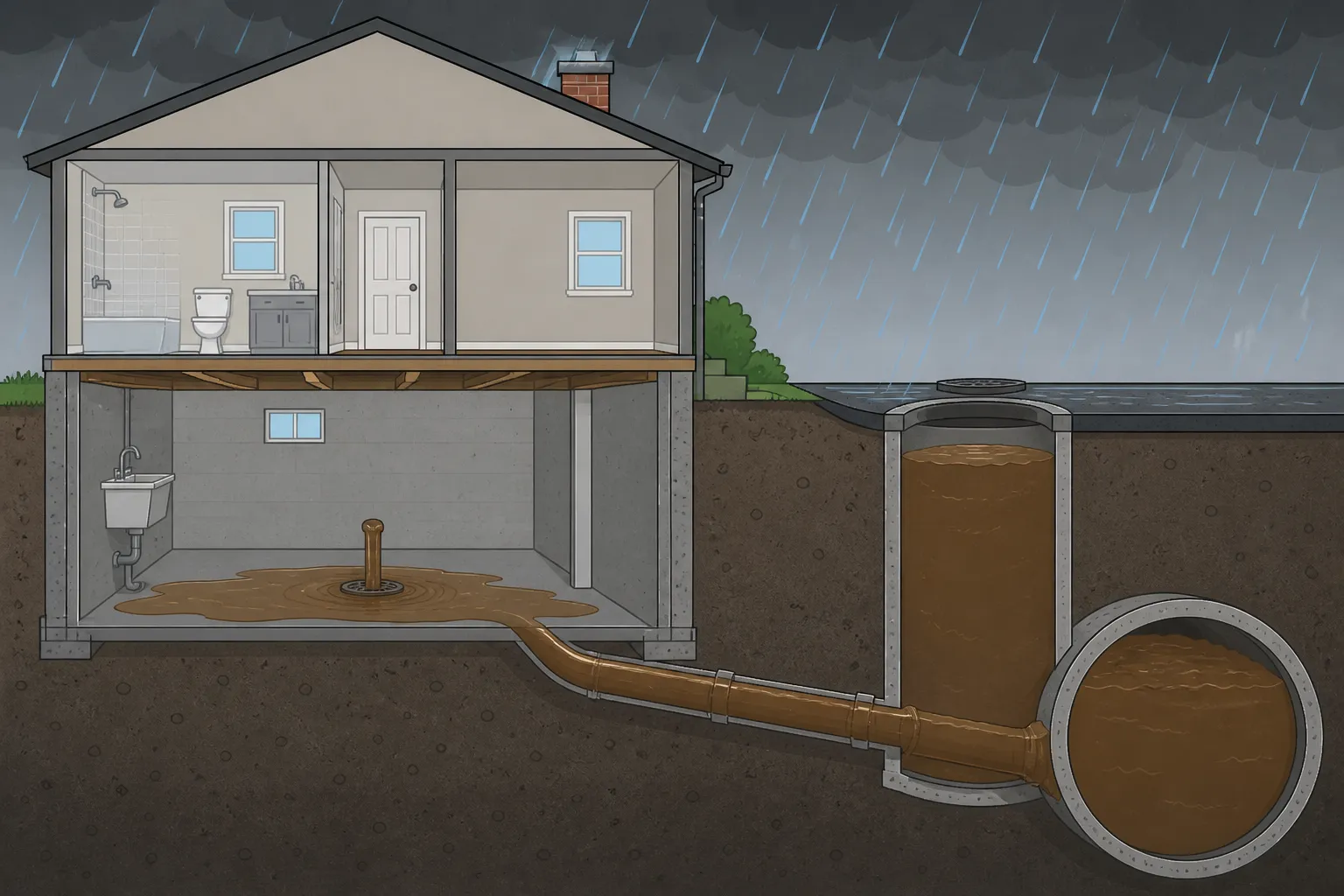
A private lateral clog from roots, grease or a collapsed pipe backs up the same way, but only into your house. One homeowner assumed toilet paper had stopped up their floor drain, and found a pool ball wedged in the footer drain when they opened the floor.
Is it the city's main or my sewer lateral?
The fastest check is your neighbors. Backups in several homes at once point to the public main; a backup in only your house points to your private lateral.
But don't guess. A camera inspection with recorded video is the only way to confirm whether the lateral is cracked, offset, or root-invaded versus simply clogged. Camera inspection identifies pipe defects. Hydrojetting a clay lateral can dislodge roots and leave an earth smell if cracked. If you suspect a lateral problem, call a plumber with a sewer camera—this isn't a DIY job.
Will a backwater valve stop my basement from flooding?
A backwater valve is a mechanical device that closes off your sewer pipe when wastewater tries to flow backward into your home. Inside the valve, a flapper or disc swings shut when reverse surcharge from the public or private sewer pushes against it. It seals the drain until the water recedes 4. That's the core promise: it stops sewage from coming up through your floor drain during a sewer backup.
But it only works if it's installed correctly. The valve must sit downstream of your floor drain and upstream of the city tap, with the flapper accessible in a pit or vault so you can inspect and clean it 5. If it's on the wrong side of the floor drain, sewage will still find its way in. And if the flapper is buried under concrete with no access, you'll never know it's jammed until the next backup.
Code requires a backwater valve in specific situations. If your plumbing fixtures' flood-level rims sit below the elevation of the next upstream manhole cover in the public sewer, you need one installed in the building drain, branch, or horizontal branch serving those fixtures 6. That's most basements with floor drains or laundry tubs below street level.
Typical mainline backwater valves are installed on a horizontal run (check the manufacturer's instructions), with the arrows on the valve hub pointing in the direction of water flow 7. The valve must not restrict drainage when open — its capacity has to at least match the pipe it serves 8. And it should carry a recognized listing like ASME A112.14.1, CSA B181.1, or CSA B181.2 5.
Sizing matters too. Backwater valves come in 1-1/2, 2, 3, 4, and 6 inch sizes with PVC or ABS hubs, so you can match your existing lateral 9. Don't guess — measure your pipe or have a plumber confirm before buying.
Finally, the valve has to be reachable. The 2024 Uniform Plumbing Code requires backwater valves and other mechanical devices to be located where they can be accessed for inspection and repair 10. If you can't get to it, you can't maintain it. A stuck-open valve is no better than no valve at all.
If you're not sure where your floor drain connects or how to cut into the main line, call a plumber. Installing a backwater valve means cutting into your building drain, which is main-line work — get it wrong and you've created a new leak point.
Why does my basement floor drain back up when it rains?
If your basement floor drain only backs up during heavy rain, the problem is likely outside your house, not inside. Rain-triggered backups often come from combined sewers or illegal connections of sump pumps and French drains into the sanitary sewer 3.
In a combined sewer system, stormwater and sewage share the same pipe. During a downpour, the pipe can't handle the extra volume. Water rises and finds the lowest opening — your basement floor drain. The same thing happens if a previous owner tied a sump pump or French drain into the sanitary line. That's illegal in most places, and it sends silt and debris into your sewer, which clogs the line over time 3.
If you have a sump pump or French drain, check where the discharge pipe goes. If it disappears into the floor or wall near a sewer line, you may have an illegal connection. A plumber can trace the line and, if needed, reroute the discharge to the yard or a storm drain. If you're not sure how to trace the line, call a plumber.
Still backing up after checking for illegal connections? The municipal sewer may be surcharging during storms. In that case, a backwater valve is the standard fix — it closes automatically when sewage tries to flow back toward your house. Installation means cutting into the main line, so it's not a DIY job. If you need a backwater valve, hire a licensed plumber.
When do sewer parts need replacing?
If you've had repeated backups or a camera inspection shows damage, replacement may be the only real fix. Cabling and jetting clear a clog, but they won't repair a cracked or offset pipe. A camera inspection with recorded video is the only way to confirm a hole or offset before you commit to digging.
Tree roots are a common culprit in older clay or cast iron laterals. Replacing an old lateral with new plastic pipe helps stop tree roots from invading the line 3. If roots have already grown through joints or cracks, even aggressive jetting can leave a strong earth or dirt smell — a sign the pipe itself is compromised.
If your lateral is decades old and you're seeing recurring root intrusion, replacement usually makes more financial sense than repeated cabling. Get a camera inspection first so you know exactly what you're dealing with.
How much does it cost to fix a sewer backup?
Sewer backup repair typically runs $500 to $2,000 for minor cleanup. Major restoration can reach $2,000 to $15,000 or more, so prevention is far cheaper 11. Backwater valve installation typically costs $800 to $2,500, depending on access and pipe material 12.
These numbers make the case for prevention pretty clearly. A backwater valve might cost a few thousand dollars up front, but it's a one-time expense compared to repeated cleanup and restoration bills.
Does homeowners insurance cover sewer backup?
Standard homeowners insurance usually excludes sewer backup unless you add a specific endorsement 3. If sewage backs up into your basement and ruins your carpet, drywall, or stored belongings, your base policy likely won't pay for the cleanup or repairs.
Ask your insurer about adding sewer backup coverage. It's often sold as a separate rider or endorsement, and the cost varies by company and your area. Some policies cap the payout, so check the limit before you assume you're fully covered.
If you've already had a backup or live in a flood-prone neighborhood, this endorsement is worth serious consideration. Without it, you're paying out of pocket for what can be a five-figure mess.
How do I clean up and dry out a basement after a sewer backup?
Cleaning up after a sewer backup isn't like mopping up a spilled drink. Sewage-contaminated water carries bacteria, viruses, and parasites, so you need to protect yourself before touching anything. Put on rubber boots, waterproof gloves, goggles, and an N95 mask before you enter the area. If the water is more than a few inches deep or covers a large area, shut off electricity to the basement at the breaker panel first — but only if the panel is dry and you can reach it safely. If the panel is wet or you're not sure, call an electrician before going near the water.
⚠️ Warning: Never run a wet/dry vacuum or any electrical appliance while standing in water. You could be electrocuted.
Start by removing standing water with a pump or wet/dry vac rated for water. Then pull out anything that got wet: carpet, padding, drywall, insulation, upholstered furniture, and cardboard boxes. Porous materials that absorbed sewage usually can't be cleaned well enough to be safe, so they need to be thrown away 13. Hard surfaces like concrete floors, tile, and metal can be scrubbed with hot water and a disinfectant — a bleach solution of 1 cup of household bleach per gallon of water works, but never mix bleach with ammonia or other cleaners.
After disinfecting, dry the space out fast. Mold can start growing within 24 to 48 hours if things stay damp, so run dehumidifiers and fans, open windows if weather allows, and keep air moving for at least two to three days. Check hidden spots like behind baseboards and under appliances for trapped moisture. If drywall or insulation got wet above the water line, cut it out and replace it — you can't dry it fast enough to prevent mold.
If the backup was caused by a main line blockage or you're dealing with more than a small area, hire a professional water damage restoration company. They have commercial drying equipment and moisture meters to make sure the space is truly dry, not just surface-dry. And if you see mold already growing or smell a musty odor that won't go away, call a pro — mold remediation is not a DIY job.
When to Call a Professional
If sewage is rising and not draining, call a licensed plumber or the city sewer department immediately. Don't wait to see if it goes down on its own. Many jurisdictions require permits for backwater valve installation and lateral replacement, so you'll need a licensed pro who can pull the right paperwork.
Before a plumber opens a trap on a main-line clog, ask whether they expect a mess and who handles cleanup and drying. One homeowner reported a plumber opening a trap released a large volume of standing sewage, and the cleanup responsibility wasn't clear beforehand. Clarify that before they pop the trap.
Frequently Asked Questions
Will a backwater valve stop every basement backup? No. A backwater valve only protects against surcharge from the public sewer. If the clog is in your own lateral between the valve and the street, the valve can't help: your own wastewater has nowhere to go and rises in your lowest drains, so stop using water and get the line cleared. 5
What slope should my building drain have? Most 4-inch building drains are laid at 1/4 inch per foot (about 2%). The IPC minimum for 3- to 6-inch drains is 1/8 inch per foot, and older lines laid at that minimum have little margin once a section settles. 5