How much does a sewer camera inspection cost in 2026?
Most homeowners pay between $250 and $500 for a sewer camera inspection, with a full range of about $100 to $800 depending on line length and add-ons 1. A typical residential camera inspection runs $150–$400 for a main line up to about 100 feet. Add a sonde locate and recorded video, and you're looking at $300–$800. Expect $100–$250 more for a second story or long lateral. If the inspection is bundled with drain cleaning, it may cost nothing extra.
A professional-grade sewer inspection rig with a tablet is a five-figure investment — the Spartan Tool Traveler 4.0 Sewer Inspection Camera with iPad (SKU 64620000) runs $11,349.50 2. That's why most homeowners hire the service rather than buy equipment.
What does a sewer scope actually show — and what should I look for in the video?
A camera inspection lets a pro see inside buried sewer pipe without digging up the yard, catching hidden issues early 3. You'll see the pipe's interior in real time. The value depends on the camera matching your lateral size and the technician running it correctly.
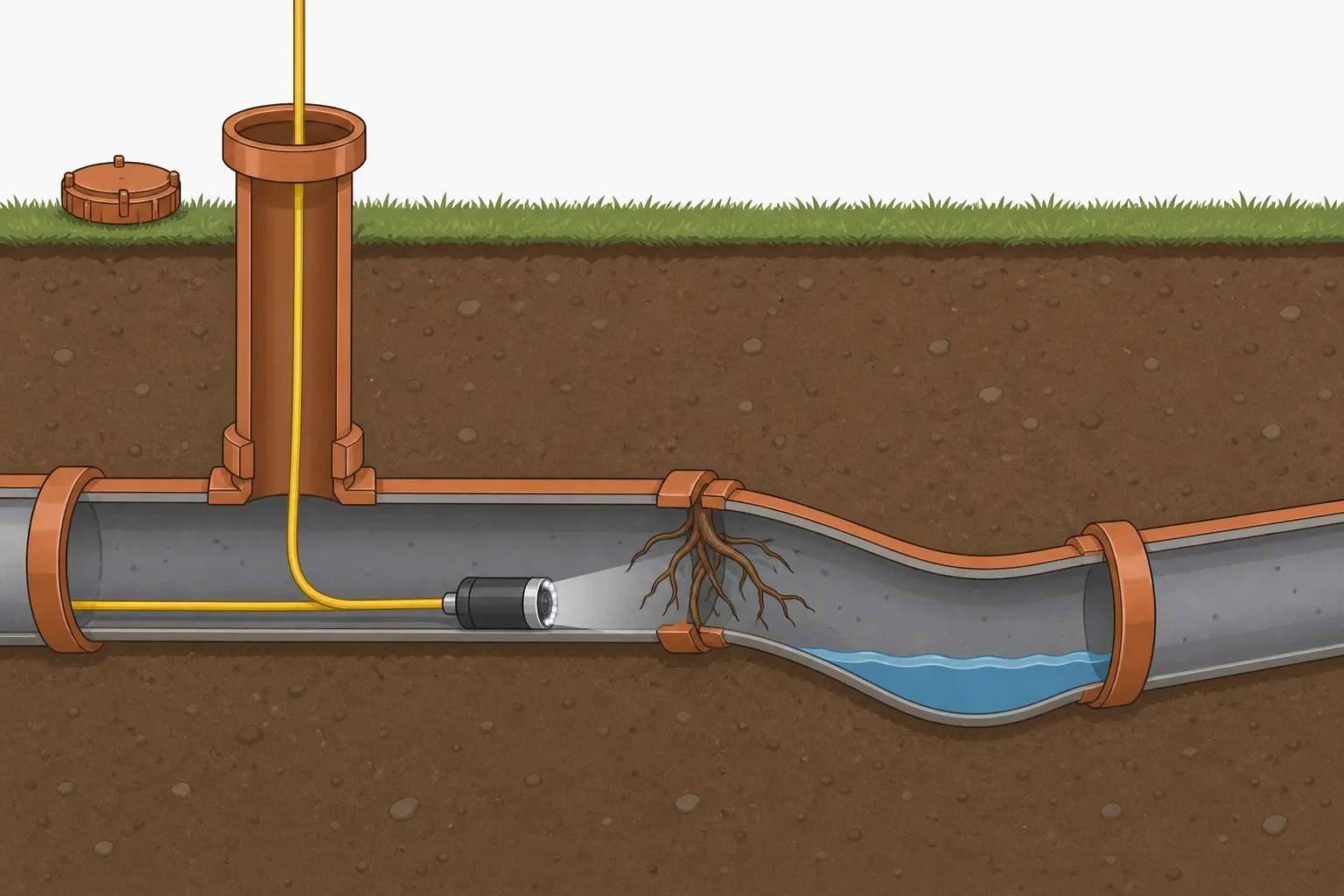
Compact push-camera reels are built for small-diameter branch lines, not mainline sewers. For example, the RIDGID microDrain APX handles lines from 1-1/4" to 3" with a 22 mm camera head and 65 ft of push cable 4. If your lateral is 4" or 6", a mid-size self-leveling camera like the SeeSnake Mini Pro covers typical residential laterals up to 8 inches 5. Full-size mainline reels, such as the SeeSnake Standard, reach much farther — up to 325 ft — and survive deeper submersion, waterproof to 330 ft 6. So the technician should match the camera to your lateral size.
Proper CCTV survey technique keeps the camera centered and running along the pipe invert, not off to one side. That's how the footage shows true slope and defects 7. If the camera drifts to the side, you can misread a belly or offset as worse than it is. Ask the tech to confirm they're following the invert.
An integrated 512 Hz sonde lets the technician pinpoint the camera head's location and depth from above ground 6. That ties defects to a distance you can compare across quotes. If one company says a break is at 40 feet and another says 60 feet, the sonde reading tells you who measured correctly.
Camera inspection is also used to find cross bores, where gas, water, or sewer lines accidentally intersect 8. The footage should be checked for unexpected pipe penetrations. A cross bore can be dangerous if a gas line was drilled through your sewer, so don't ignore a strange object in the video.
When you watch the footage, look for standing water, visible cracks, roots, offset joints, and any object that doesn't belong. A good tech will narrate as the camera moves, marking distances and calling out defects. If the video is silent or the camera jumps around, ask for a re-run or a second opinion.
Is a sewer scope required when buying a house, and who pays for it?
Most home purchase contracts don't automatically include a sewer scope. You'll usually need to request one as part of your inspection contingency, and you'll typically pay for it yourself — often $200 to $500, depending on your market and the length of the line. Some buyers split the cost with the seller. In rare cases a seller will cover it to keep the deal moving.
Sellers in some areas are now required by the municipal sewer authority to scope for groundwater infiltration and repair before the sale or a use-and-occupancy certificate will issue. That makes the inspection the seller's obligation, not the buyer's. This is more common in older municipalities with combined sewers or known infiltration problems.
If you're buying, don't let a seller's reassurance replace the footage. Buyers report being told root intrusion is "typical for the area, just rod it once a year" — which is sometimes honest and sometimes a way to avoid disclosing a line that is already on borrowed time. The footage, not the reassurance, should drive the decision. Ask for a copy of the video and the inspector's written notes, not just a verbal summary.
The camera itself has to fit the pipe. Most house laterals are 4-inch pipe, and under the IPC a drain serving a toilet can't be smaller than 3 inches 9, so a standard push camera fits nearly any residential sewer.
Where an existing sewer is replaced by pipe bursting, the IPC (Section 716.3) requires an internal recorded video camera survey before work begins 9. That survey must note cleanout positions and connection depths, so you'll have a baseline record before the new line goes in. If you're selling a house and the buyer requests a scope, you may be able to use that pre-replacement survey as evidence of the line's condition at the time of replacement.
My sewer scope shows roots and a belly — is that a dealbreaker or just maintenance?
If your scope shows roots at joints and a minor belly, experienced plumbers say it's often manageable with annual rodding. You'll clear the roots before they choke the line. But a belly that holds standing water is a different story. Many plumbers use a working rule of thumb: once about an inch of water sits in the pipe over several feet, solids start settling out and the line tends to back up no matter how often it's rodded. That's field experience, not a code limit, so ask the plumber to show you the water's depth and length on the footage.
One homeowner reported that a scope showing roots and a belly led to advice to walk away unless the price was a steal. Visible defects often hint at hidden unpermitted repairs. If that's what you can see, what's behind drywall and siding? That's the kind of uncertainty that makes a dealbreaker call reasonable.
So the practical rule: minor root intrusion plus a shallow belly? Budget for annual maintenance and you'll probably be fine. A deep belly with standing water? That's a repair you'll need to price into the purchase — or a reason to walk.
How do I read a sewer scope report: slope, standing water, cracks, and offsets
A sewer scope report can look like a foreign language if you've never seen one. You'll see terms like "belly," "offset," and "standing water" — and each one tells you something specific about how your line is performing.
The UPC doesn't set one minimum size for a building sewer: it's sized by how much drainage it carries, and it can never be smaller than the building drain feeding it (UPC 717.1). Slope must be at least 1/4 inch per foot, though where that isn't practical, the local inspector can approve 1/8 inch per foot on 4- to 6-inch pipe (UPC 718.1) 10. For a 4-inch lateral, 1/4 inch per foot (about 2%) is the usual target; the IPC allows as little as 1/8 inch per foot for 3- to 6-inch pipe. As noted above, how deep the water sits and over what distance matter more than whether there's any at all. So when you see "standing water" on a report, look at how much and over what distance. A little pooling at a joint is normal, but a long, flat section with an inch or more of water is a red flag.
Cracks show up as dark lines or separations in the pipe wall. Hairline cracks may not leak yet, but they'll grow. Offsets are when two pipe sections no longer align — often from ground settling or root pressure. A small offset might just catch debris; a large one can block the line entirely.
If the report shows a belly with significant standing water, you'll likely need a spot repair or full replacement depending on the length and location. If it's just a minor offset, a plumber might be able to pull the line back into alignment or line it with a cured-in-place pipe. But don't guess — have the plumber walk you through the video so you can see exactly what they're describing.
Sewer camera inspection vs. sewer line replacement: when is repair worth it?
A camera inspection tells you what's wrong, but it doesn't fix anything. The real question is whether a spot repair will hold or if you're looking at a full replacement. Replacement costs vary widely depending on your situation. A typical 4-inch lateral runs $4,000–$15,000. Long runs, deep bury, street or sidewalk cuts, or city right-of-way work can push that to $15,000–$30,000 or more. Trenchless options like pipe bursting or CIPP lining run roughly $80–$250 per linear foot.
If the camera shows a single crack or a separated joint with otherwise sound pipe, a spot repair might buy you years for a fraction of replacement cost. But if you're seeing multiple failures, root intrusion throughout the line, or pipe that's collapsed in more than one place, patching becomes a losing game. You'll spend money on repairs that don't address the underlying condition of the pipe.
One thing I've noticed from cost data is that homeowners often underestimate how quickly trenchless methods become cost-competitive once you factor in landscaping restoration, driveway replacement, or street permits. The camera footage gives you the evidence you need to make that call without guessing.
Can I trust the plumber's read of my sewer scope — and how do I get a second opinion?
A camera inspection is a diagnostic, not a repair authorization. Before you sign anything, get the recorded video and a written report with footage marks. Then get at least two independent quotes for any repair over a few thousand dollars. If the scope shows a void under a slab, call a structural engineer before committing to a repair. Permits are generally required for any lateral repair or replacement, though a scope alone doesn't need one.
Homeowners have found that a scope done a year earlier can conflict with a new plumber's read of the same line. If that happens, ask the original inspector to re-review the footage against the new findings. It's often free and worth doing before you accept a five-figure replacement quote.
Frequently Asked Questions
Is a sewer scope required for a home sale?
No, a sewer scope isn't typically required by code for a home sale. The International Plumbing Code doesn't mandate a scope for sale, only for replacement work 9. But some municipalities require it for infiltration testing, and buyers often request it as a contingency. Local sewer authorities sometimes impose stricter infiltration-testing requirements at sale, so check with your local building department before listing or buying 7.