Your sewer cleanout is a capped pipe, usually 3 or 4 inches wide, that gives you direct access to the main drain line. You'll find it near where the sewer leaves your house: a short pipe sticking out of the basement floor, a crawlspace, or the yard near the foundation. Open it, and you can snake a main-line clog without pulling a toilet. Here's where to look, how to open it safely, and what it's telling you when water comes out.
Where is my sewer cleanout located?
Finding your cleanout starts with knowing what the plumbing code expects. Code requires a cleanout at the junction of the building drain and building sewer, or within 10 feet upstream of that junction 1. That's why most homes have one near the foundation wall where the main line exits.
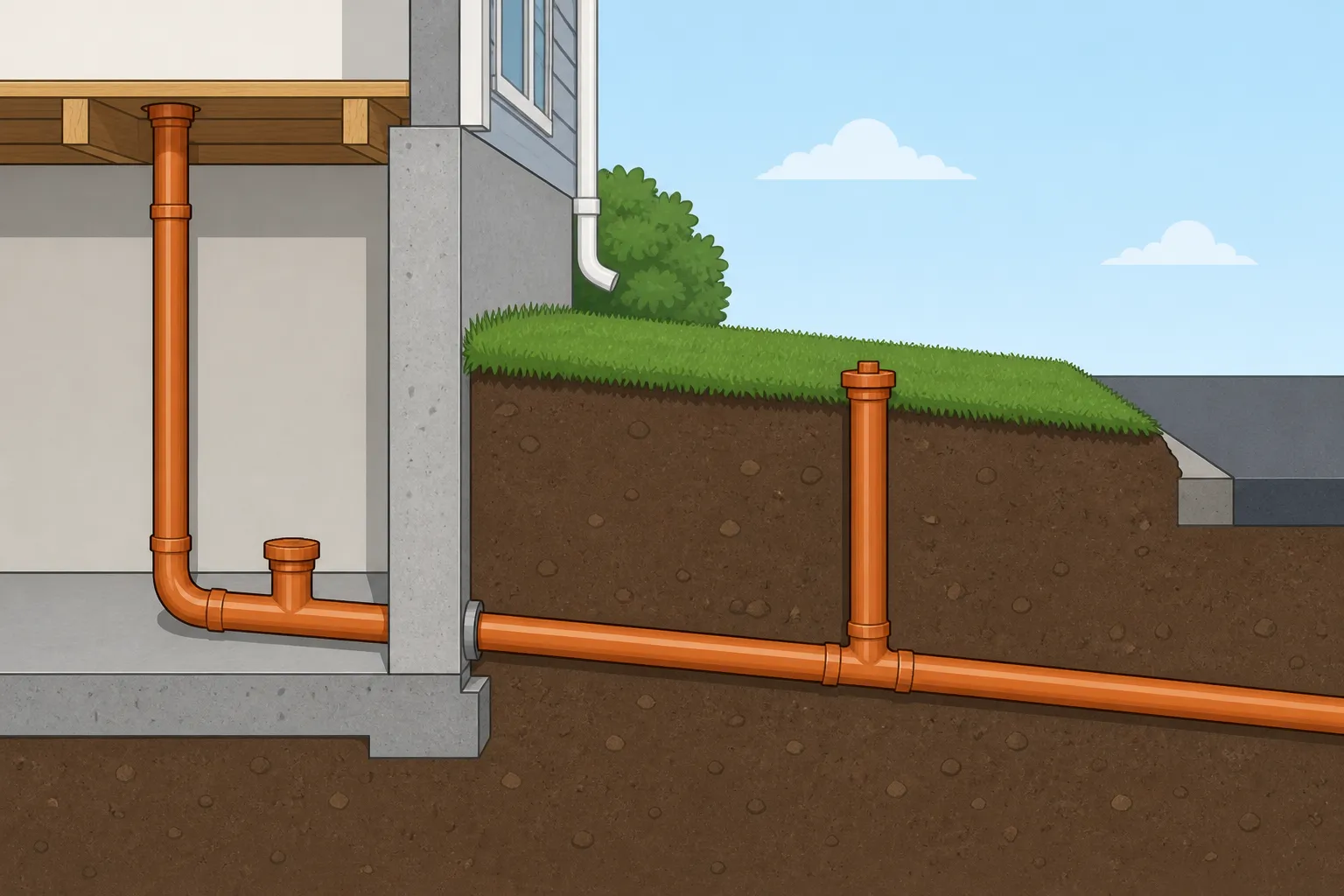
Horizontal drains inside a building need a cleanout at least every 100 feet. Building sewers follow the same 100-foot spacing 2. Every waste or soil stack must have a cleanout at its base, which is why you often find one in a basement near the main stack 3.
A cleanout needs working clearance of at least 18 inches for 6-inch and smaller piping, so it should not be boxed in tight 4. If you see a pipe stub against a wall with barely room to grip the cap, that's a code violation and a future headache.
Cleanouts are typically 3-inch or 4-inch PVC or cast iron. The cap is either a screw-in plug with a square or hex nut on top, or a fit-all cap that taps into the hub. That's how you tell it apart from what's nearby: a floor drain has a flat grate, and a water shutoff is a much smaller valve on a supply pipe.
A cleanout at the house exit (building drain) lets you snake downstream. A cleanout at the property line or curb lets you work upstream toward the house. If water backs up only at your lowest fixtures, the clog is likely between the house and the street, so start at the house cleanout.
Many pre-1960s homes were built without a two-way cleanout, forcing sewer work through a toilet, roof vent, or excavation 5. If your house is that old and you can't find one anywhere, it may simply not exist. A plumber can install one or clear the line through another access point.
How do I open and use my sewer cleanout?
Before you rent a snake, have the rental counter match the cable to your pipe. As a rough guide, 3/4-inch to 7/8-inch sectional cables are common for 4-inch lines and 5/8-inch cables for 3-inch lines, but the machine maker's sizing chart is what counts. Start with a cutter blade noticeably smaller than the pipe, around 2 to 3 inches in a 4-inch line, and step up only if it passes. A cutter the same size as the pipe is the one most likely to jam.
Step 1: Check whether the line is full. Look at the lowest drain in the house. If it's backed up, the cleanout pipe is full of sewage under a few feet of pressure head, so put on gloves and eye protection and have towels and a bucket ready.
Step 2: Loosen the cap slowly. With a pipe wrench on the square nut, turn the cap a quarter turn at a time and let any trapped water seep out before you take it off. Stand to the side, never over the opening.
Step 3: Feed the cable in and work the clog. Push the cable in slowly, rotating clockwise, until you feel resistance. Run it back and forth through the blockage a few times, then retract it.
Step 4: Flush, test and recap. Run a tub or several toilet flushes to confirm the line drains, then thread the cap back on hand-tight plus a quarter turn. If the clog won't clear, the cable keeps stopping at the same spot, or you'd need a power snake you've never used, call a plumber.
If it backs up again within weeks, the pipe itself is likely the problem: roots regrowing at a joint, a sag (belly) that collects sludge, or a break. A camera inspection will show which.
Why is water coming out of my cleanout when I flush?
If water comes out of the cleanout when you flush, the blockage is downstream of that opening, between the cleanout and the street. That's useful information: it means the cleanout is exactly the right place to snake from. One homeowner had a plumber insist the sewer wasn't clogged, yet water came out of the cleanout on every flush. The problem turned out to be further down the line.
The hydraulics are simple. Water always takes the lowest open exit. When the main line is blocked, wastewater fills the pipe back up toward the house until it reaches the lowest opening, and an uncapped or loose cleanout is usually lower than any fixture.
What if a plumber tells you the line isn't clogged and water still backs out of the cleanout? Experienced plumbers point to three likely causes: a snake that was too short, a missing cutter head, or a soft blockage the snake passed through. If the snake doesn't reach the clog, it can't clear it. A missing cutter head means the cable just slides past the blockage without grabbing it. And soft blockages — like grease or sludge — can close back up after the snake passes through. The line seems clear, but water still backs up.
If you're snaking from the cleanout yourself and water keeps coming out, check your equipment first. Make sure the snake is long enough to reach the main line and that the cutter head is attached. If you've done that and water still backs up, call a plumber. A soft blockage often needs a hydro jetter to fully clear the line.
How do I keep my lawn cleanout from getting damaged?
Lawn cleanouts take a beating from mowers, trimmers, and roots. One homeowner's cap was destroyed by a push mower blade, and they couldn't figure out the replacement size. The fix was measuring the pipe's outside diameter and matching a 3-inch or 4-inch fit-all cap that taps on rather than threads. The best long-term protection is a traffic-rated cast iron cleanout box with a bolt-down lid. A 6-inch or 8-inch CC box keeps the cleanout below grade, so mower blades pass over it and roots and debris stay out.
Heavy-duty cast-iron boxes for 8-inch connections typically measure about 11 inches inner diameter and 8 inches tall, weighing around 44 pounds 6. That's a solid chunk of metal, but it's what you want if you're tired of replacing cracked PVC risers.
One mistake working plumbers see all the time: homeowners cut a PVC cleanout riser at an angle and expect the fitting to glue flush. The hub stops on the high side, so the pipe never seats properly. Cut the pipe square, or use a cast iron CC box to cover the angled cut. If you're not confident cutting PVC square with a handsaw, call a plumber for this step.
Sewer cleanout cost: DIY snaking vs professional
Clearing a clog through an existing cleanout costs far less than installing one. You'll typically pay $150 to $500 for snaking and $300 to $1,000 for hydro jetting 7. Installing a two-way sewer cleanout runs $1,400 to $3,500. Most homeowners pay around $2,000 to $2,700 8.
If you already have a cleanout, start with the cheaper option. A drain snake you can rent or buy will handle most soft clogs. For grease or scale buildup, hydro jetting clears the pipe walls more thoroughly. But if your line keeps backing up and you don't have a cleanout, the installation cost may be worth it for future access.
When comparing quotes, ask whether the price includes excavation, backfill, and any required permits. A two-way cleanout gives you access in both directions, which is why it costs more than a one-way fitting. Get at least three estimates before committing.
When should I call a plumber instead of DIY?
Call a licensed plumber if you can't locate a cleanout, if it's buried under concrete or landscaping, or if water backs up from multiple fixtures at once. These situations usually mean the problem is beyond a simple drain clearing. Adding or relocating a cleanout usually requires a permit and inspection in most jurisdictions 9. A licensed plumber can handle the permit, do the work to code, and arrange the inspection so you don't get stuck with a failed project.
Frequently Asked Questions
How many cleanouts does my sewer line need? Under the Uniform Plumbing Code, each horizontal drainage pipe needs a cleanout at its upper terminal and another for every 100 feet of developed length 10. A 150-foot run would need at least two cleanouts — one at the start and one at the 100-foot mark.
Where are cleanouts required at bends? The UPC requires a cleanout at each 135-degree aggregate change of direction 11. If your sewer line makes a sharp turn or a series of bends that add up to 135 degrees, you'll need a cleanout there to keep the line accessible.
Do I need a cleanout where my house drain meets the sewer? Yes. The UPC requires a cleanout at the junction between the building drain and building sewer 11. This is usually where your home's plumbing exits the foundation and connects to the municipal line or septic tank.