How much does sewer pipe relining cost compared to replacement?
Relining a sewer line typically costs $80 to $250 per linear foot, depending on pipe diameter and how much damage there is. For a standard 4- to 6-inch lateral, you're looking at $100 to $200 per foot on average 1. Dig-and-replace, by contrast, runs $150 to $450 per linear foot — or $7,000 to $30,000 for a full lateral — which is why relining often wins on price alone 2.
A realistic budget for relining a 4-inch residential lateral is $4,000 to $15,000, roughly $60 to $150 per linear foot depending on liner type. Add $300 to $800 for pre- and post-lining camera inspection. That's still usually cheaper than excavation, especially when you factor in landscape restoration and driveway repair.
If your line is under a slab, under mature trees, or crosses a busy street, the cost gap widens further. Relining avoids most of that surface disruption, so the total project cost stays closer to the per-foot liner price.
How long does a relined sewer pipe last?
Under proper design, installation, and maintenance, a CIPP sewer liner typically lasts 50 years or more 3. A published study found CIPP rehabilitation has a median service life of 70 to 80 years based on current installations 4. Real-world life depends on host pipe condition, resin type (epoxy vs. polyester), and installation quality — the 50-year figure is a manufacturer warranty claim, not a guarantee.
How does sewer pipe relining actually work?
Cured-in-place pipe (CIPP) relining inserts a flexible resin-saturated fabric liner into your existing sewer and cures it in place to form a new pipe inside the old one 5. The liner is a felt tube coated with a thermosetting resin. Once it's in position, heat or ultraviolet light hardens the resin, creating a rigid, smooth-walled pipe that hugs the inside of your old sewer.
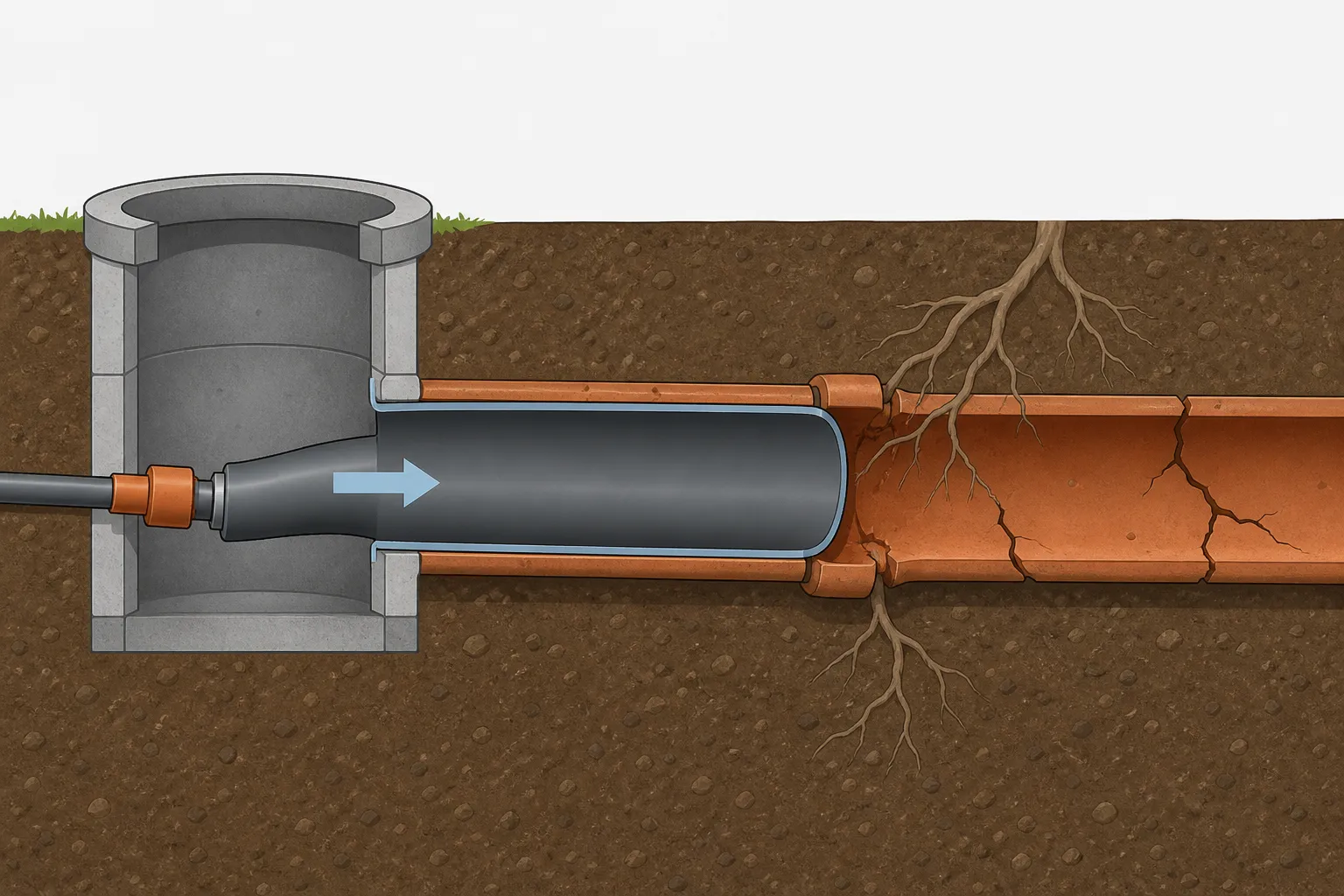
The process is governed by ASTM F1216, which covers rehabilitation of existing pipelines by inversion and curing of a resin-impregnated tube 6. That standard sets the benchmark for how the liner should perform. For example, the cured material must meet minimum structural benchmarks of 31 MPa flexural strength and 1724 MPa flexural modulus under ASTM F1216 7. These numbers matter because they tell you the new pipe can handle the same loads and pressures as a traditional pipe.
Installation has to follow the manufacturer's specified cure times and temperatures to achieve a continuous tight fit to the host pipe's internal circumference 8. If the resin doesn't cure fully, you'll get soft spots or wrinkles that can catch debris and lead to clogs. That's why experienced plumbers won't rush this step.
There are two main curing methods. Traditional CIPP uses hot water or steam to cure the resin. UV-cured CIPP liners use a glass fiber reinforced felt tube and resin system cured by ultraviolet light 6. UV curing is faster and doesn't require managing large volumes of hot water, but both methods produce a structurally sound liner when done correctly.
From my analysis of water pressure dynamics, the tight fit is what makes relining work long-term. The liner isn't just a patch — it becomes a structural pipe that resists root intrusion and ground movement. That's why the ASTM standards are so specific about strength and modulus.
Does relining shrink the pipe and slow drainage?
Yes, relining reduces the pipe's inside diameter. A CIPP liner in a 4-inch lateral is typically about 3 mm thick (4.5 mm at most), so the cured liner trims the inside diameter by roughly 1/4 inch, about 5 to 7 percent. That loss matters on long, flat runs where the pipe was already close to its minimum slope.
Most articles sell the trenchless convenience and never mention the capacity penalty. The engineer's job is checking whether the host pipe's remaining capacity, slope, and root/offset condition can absorb the diameter loss and added wall roughness. The IPC minimum slope for a 4-inch lateral is 1/8 inch per foot, with 1/4 inch per foot the usual target, and a liner on a back-pitched or bellied section will not fix standing water.
If your line already drains slowly or sits nearly flat, relining can make things worse. A camera inspection and slope check before you commit will tell you whether the liner leaves enough capacity for your household's flow.
Is pipe relining or spot repair better for root intrusion?
Root intrusion doesn't automatically mean you need a full reline. Working plumbers often see cases where the visible damage is limited to one section, and a spot repair of that run is the honest fix. One homeowner with root intrusion was told total replacement, but the visible damage was limited to one section — spot repair of that run was the honest fix.
Before you commit to relining, rule out simpler causes. A homeowner with a 2016-replaced toilet draining slow found the real problem was crusted buildup where newer ABS tied into old cast iron downstream — snaking, chaining, or hydro jetting fixed it, not a new line. Working plumbers report that wipes and tampons snag easily on old cast iron, so a slow drain is not automatically a relining case.
If a camera inspection shows roots entering at one or two joints, spot repair or sectional lining can address those points without lining the whole run. Full relining makes more sense when roots have infiltrated multiple joints or the pipe is structurally weak along its length. Ask your plumber to show you the camera footage and explain why the damage warrants a full liner rather than a targeted fix.
When is relining a bad idea and replacement is the only fix?
Relining isn't a magic fix for every sewer problem. The host pipe has to be cleaned and roots cut before a liner goes in. If the joints are offset more than about 1/4 inch, sections have collapsed, or water is actively infiltrating, a liner usually won't work. In those cases, replacement is the only real fix.
Code requirements add another layer. IPC Chapter 7 sets slope and sizing rules for sanitary drainage. A gravity sewer has to pass a test where you plug the connection at the public sewer, fill the line with water, and hold at least a 10-foot head for 15 minutes 9. If your line can't hold that, relining won't solve the underlying problem.
Before you pay for a liner, get a pre-lining camera video and a written warranty that names the liner thickness and resin. If the line is bellied, back-pitched, or the host pipe is structurally gone, a licensed plumber and possibly an engineer should confirm replacement is the right call. A liner installed over a collapsed or badly offset pipe will fail early.
⚠️ Warning: If your sewer line has collapsed sections or active infiltration, don't attempt relining. You could end up with a liner that fails within months and a bigger repair bill.
What should I ask a contractor before signing for relining?
Before you sign anything, pin down the liner's specification. Ask whether the liner meets ASTM F1216 and what thickness was engineered for your pipe. Get a pre-lining camera video and a written warranty that names the liner thickness and resin. That written guarantee matters more than a sales pitch.
If you're getting conflicting opinions, slow down. One homeowner had contractors give conflicting diagnoses on the same line. They got two more quotes and leaned on written guarantees rather than the loudest opinion. It's a good strategy when the stakes are high.
If anyone in the house is sensitive to fumes, ask about styrene-free resin. Some CIPP systems use a styrene-free resin to reduce hazardous air pollutants and environmental impact 10. It's worth asking about before the crew arrives.
Frequently Asked Questions
What pipe sizes can be relined? Trenchless sewer rehabilitation works on lines from 4 inches to over 60 inches in diameter, so a standard residential lateral is well within range 11.
How long has CIPP been around? CIPP has been used since the 1970s to rehabilitate gravity sanitary and stormwater sewers, with a typical design life exceeding 50 years 12.
Is trenchless really cheaper than digging? Since the 1990s, trenchless rehabilitation has become more cost-effective and easier to implement than open-cut replacement 13.
What pipe standards apply to trenchless replacement? Trenchless sewer replacement systems require a minimum SDR-17 pipe, and ASTM F891 PVC sewer piping must be PS 100 or PS 50 14.