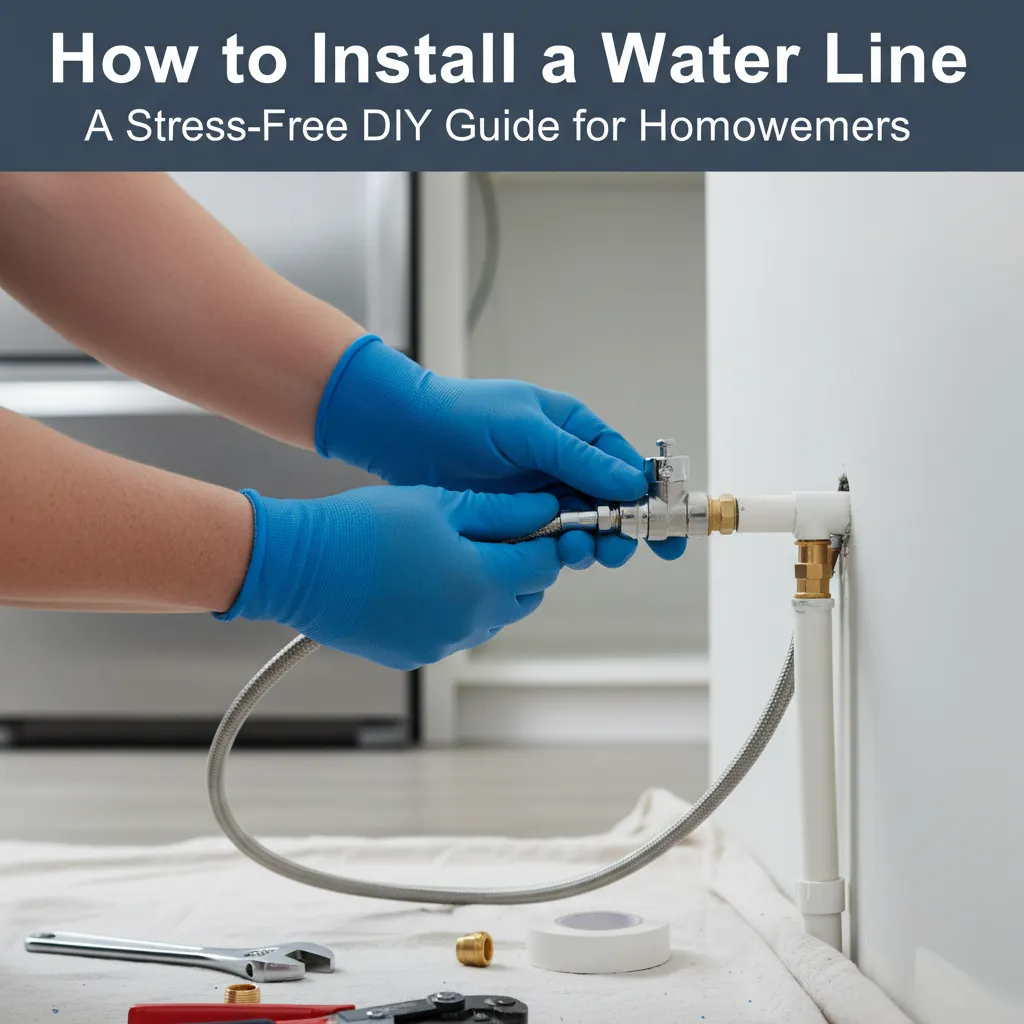
Adding a water line to a refrigerator ice maker, reverse-osmosis unit, bidet, or under-sink filter is one of the more approachable plumbing projects — small-bore, low flow, and all the connections are accessible. The job is mostly picking the right shutoff, running 1/4" PEX cleanly, and pressure-testing before you close up the cabinet.
Scope note: This guide covers small-bore appliance hookups only. If you're installing, replacing, or resizing a whole-house supply line — main line from the meter, branch runs through walls, or a repipe — see Water Line Installation: A Complete Guide for pipe sizing, code requirements, and whole-system planning.
Tools Needed
- Adjustable wrench (for tightening fittings without stripping)
- Tube cutter (guarantees clean cuts on plastic/metal tubing)
- Deburring tool (removes sharp edges inside cut pipes)
- Drill with 1/4" bit (for piercing cabinet walls)
- Teflon tape (seals threaded connections)
- Pressure gauge (optional but recommended for leak testing)
Materials Needed
- PEX tubing (1/4" or 3/8" OD - NSF-rated for potable water)
- Shut-off valve (angle stop or saddle valve - brass recommended)
- Compression fittings (matched to tubing size - avoid plastic)
- Pipe clamps (stainless steel for securing tubing every 2 ft)
- Foam insulation sleeves (for lines in unheated spaces like garages)
- Safety glasses & work gloves (non-negotiable!)
Step-by-step
Step 1: Shut Off Water & Map Your Route
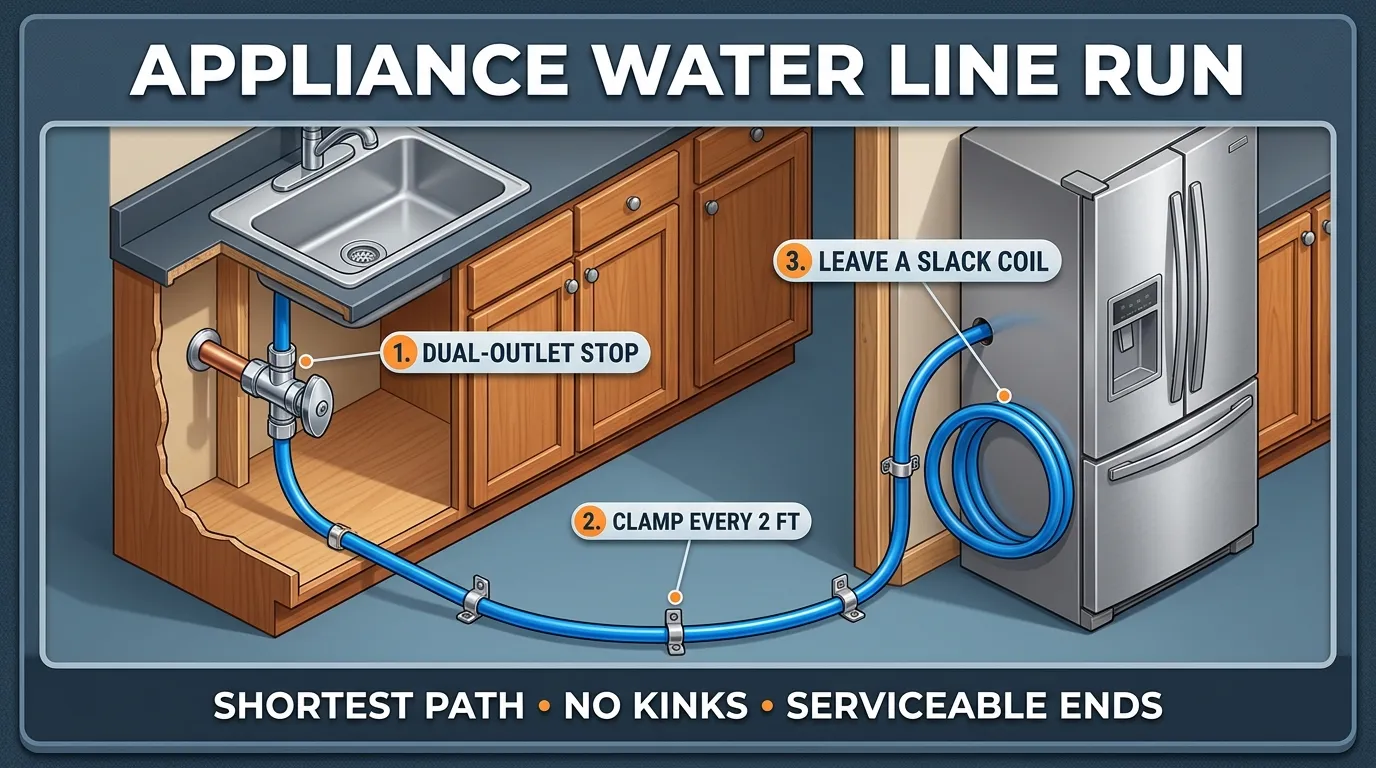
Locate your main water shut-off valve (usually near the water meter or where pipes enter the house) and turn it clockwise until tight. Open a faucet to drain residual pressure. Now plan your tubing path: shortest distance from the water source (like an existing pipe under the sink) to the appliance, avoiding sharp bends or heat sources. Tip: Use masking tape to mark the route on floors/walls.
⚠️ Warning: Never skip shutting off the main water! A surprise geyser can cause thousands in damage.
Step 2: Install a Dedicated Shutoff
The correct tap for an appliance water line is either (a) a dual-outlet angle stop that replaces the existing fixture angle stop and gives you a second 1/4" outlet for the appliance, or (b) a tee adapter threaded onto the existing angle stop's outlet. Both give you a real, serviceable quarter-turn shutoff sized for the tap.
Shut the cold-water supply, unthread the existing angle stop or fixture line, apply Teflon tape to the male threads (do not put Teflon on compression ferrules or compression nut threads), and install the dual-outlet stop or tee. Snug with a wrench — roughly 1/4 turn past hand-tight on brass. Put a small bucket under the joint before you re-pressurize.
⚠️ Do not use self-piercing "saddle valves." They are widely regarded as unreliable — the small rubber seat fails over time, the tiny pierce hole clogs, and many local codes disallow them for potable water. Use a dual-outlet angle stop or a tee adapter on the existing angle stop instead.
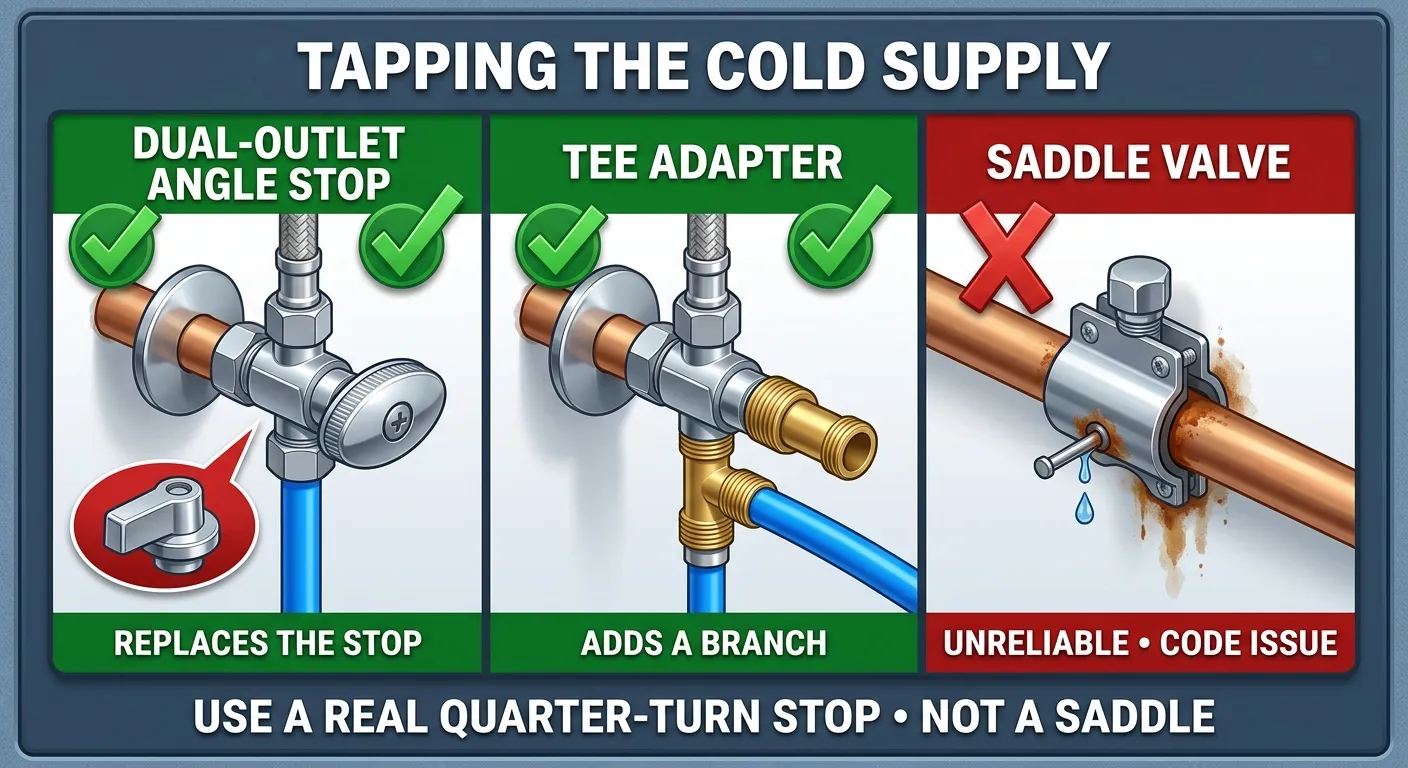
⚠️ Don't overtighten. Brass angle stops crack if you crank them. If you feel strong resistance before full seat, stop and check that the threads aren't cross-threaded.
Step 3: Measure, Cut & Deburr Tubing
Run PEX tubing along your taped route. Add 12" extra for slack. Use the tube cutter to make a clean perpendicular cut—no saws (they create burrs that cause leaks!). Swivel the deburring tool inside/outside the cut end to remove plastic shavings. Pro secret: Shine a flashlight through the tube—if you see light clearly, it’s debris-free.
⚠️ Warning: Wear safety glasses! Plastic shards fly when cutting.
Step 4: Connect Fittings & Secure Tubing
Slide a compression nut and ferrule (brass ring) onto the tube end. Push the tube fully into the fitting until it bottoms out. Hand-tighten the nut, then give it a 1/4 turn with a wrench. Repeat at the appliance end. Every 2 ft, secure tubing to studs or joists with clamps—no sagging! Tip: Avoid kinks by coiling excess tubing in wide loops.
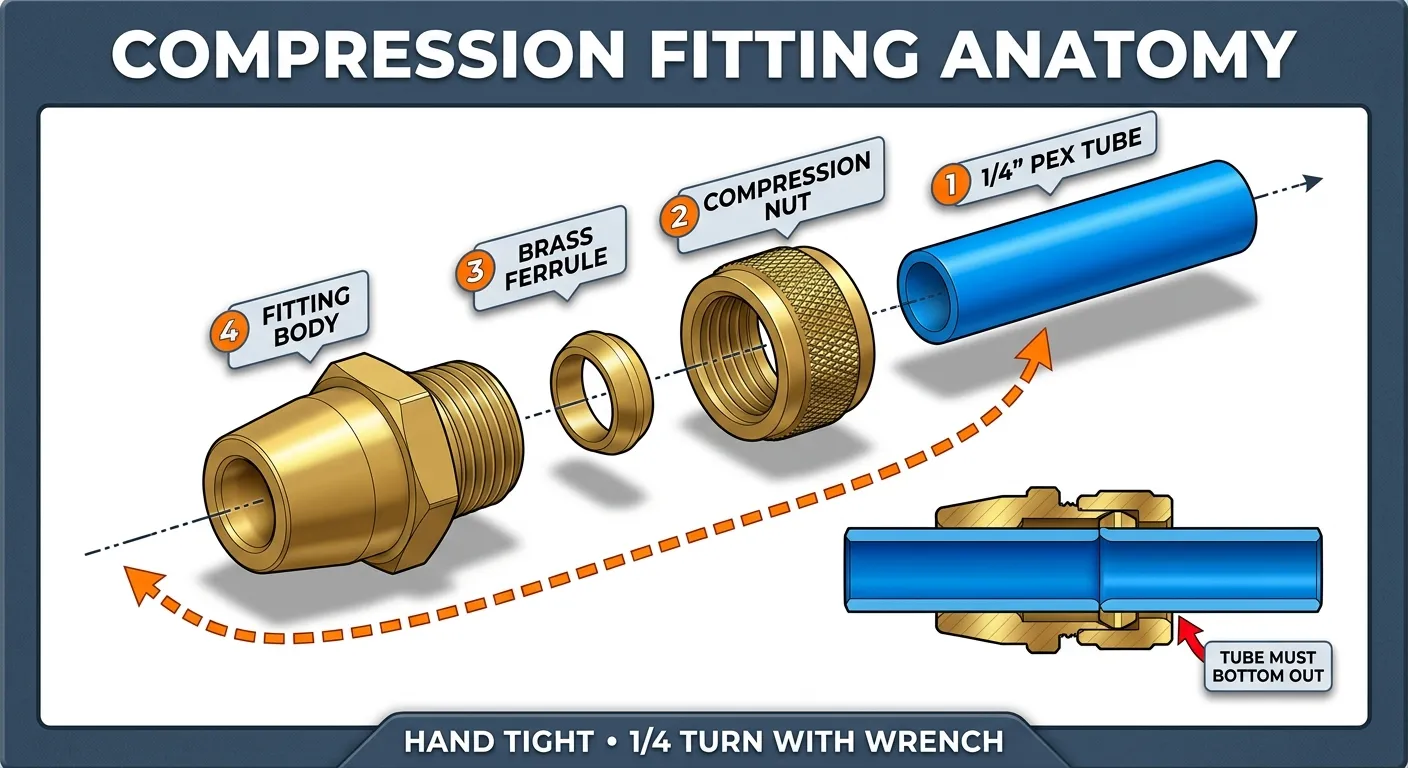
⚠️ Warning: Kinked tubing reduces water flow and bursts under pressure.
Step 5: Pressure Test Before Celebrating
Slowly turn the main water back on. Open your new shut-off valve. Check EVERY connection with a paper towel—even tiny leaks show as dark spots. Wait 30 mins. No drips? Test water flow at the appliance. Still dry? You’ve nailed it! Insider move: Leave the paper towels under connections for 24 hours as a final check.
⚠️ Warning: If you see ANY moisture, immediately shut off water and re-tighten fittings.
Pro Tips
- Use colored PEX (blue = cold, red = hot) to avoid confusion later.
- Keep tubing 6" away from hot surfaces like dryer vents.
- Wrap foam insulation around lines in cold spaces to prevent freezing.
- Buy 25% extra tubing—it’s cheap insurance against measuring mistakes.
- Smear a dab of dish soap on connections to make bubbles appear during leak tests.
When to Call a Professional
Call a licensed plumber if: the only available cold-water source requires opening a finished wall or soldering copper, the existing angle stop is seized or corroded and won't close fully, you're on galvanized steel (draining and re-pressurizing can dislodge scale through every fixture), or leaks persist after two careful rebuilds of the connection. For anything involving the main house supply line or a new branch line through framing, see the Water Line Installation pillar — that's a different project.
Understanding the Problem in Detail
Small-bore appliance water lines fail at three points: the tap into the existing supply (a saddle valve's piercing pin, a cross-threaded angle stop, a push-to-connect on a dirty cut), the run itself (kinks, UV damage on exposed tubing, a crushed clamp), and the appliance end (a loose compression nut, a tired braided hose). 1/4" PEX handles the run well — it's flexible, tolerates some freeze expansion, and doesn't corrode. Just note that PEX is freeze-tolerant, not freeze-proof: extended freezes or a freeze at a brass fitting will still rupture it.
Tools and Materials Guide
PEX vs. copper: PEX wins for DIY appliance hookups (no soldering, flexible runs). Buy NSF/ANSI 61 rated tubing from a home center. Pair it with a dual-outlet angle stop or a tee adapter on the existing stop — skip saddle valves entirely. For connections, brass compression fittings are the traditional DIY pick; UL-listed push-to-connect fittings (SharkBite, Tectite) also work well on 1/4" and 3/8" potable runs and are forgiving of imperfect cuts. A $15 tube cutter is all you need for clean cuts.
Safety Considerations
- WATER OFF: Double-check with a faucet test. 2) EYE PROTECTION: Tubing cuttings fly. 3) NO ELECTRICAL RISKS: Keep away from outlets. 4) SLIP HAZARD: Wipe spills immediately. 5) MOLD PRECAUTION: Wear a mask if opening damp walls.
Troubleshooting Common Issues
- Leak at fitting: Tighten compression nut 1/8 turn more. Still leaks? Cut tubing 1" back and redo the connection. - Low water pressure: Check for kinks or undersized tubing (use 3/8" for fridges). - Gurgling noises: Air in line—run water for 2 mins to purge. - Frozen line: Shut off water immediately and thaw with a hairdryer (never open flame!).
Maintenance and Prevention
Every 6 months: Check for moisture under sinks — a small weep at a compression nut now is a flooded cabinet later. Annually: Exercise the shutoff (turn fully off, then back on) so the stem doesn't seize. Replace braided stainless or rubber flexible appliance supply hoses every 5–8 years — those are the hoses that fail, not the PEX itself. Insulate any run that passes through a garage or crawl space before winter.
Cost Analysis: DIY vs Professional
DIY: $50–$150 (tubing, valve, fittings). Pro install: $250–$500+. Save by: Buying PEX in bulk, reusing existing valves, and skipping unnecessary accessories. Emergency leak repair: $500–$5,000+ (why prevention matters!).
Related Plumbing Problems
- Fixing a leaky faucet
- Replacing a stuck or corroded angle stop
- Installing a dishwasher drain line
- Winterizing pipes before a freeze
- Whole-house supply-line projects — Water Line Installation: A Complete Guide
Frequently Asked Questions
Can I use a garden hose for my fridge water line?
Absolutely not! Garden hoses aren’t food-grade and can leach lead or chemicals into drinking water. Always use NSF-certified PEX tubing.
Why does my new water line taste/smell like plastic?
Flush the line for 5 minutes—residual manufacturing oils are common. If it persists after 48 hours, swap to a different brand of PEX (some have lower odor thresholds).
How tight should fittings be?
Hand-tight plus 1/4–1/2 turn with a wrench. Overtightening cracks fittings. If it leaks, tighten incrementally—don’t crank it!