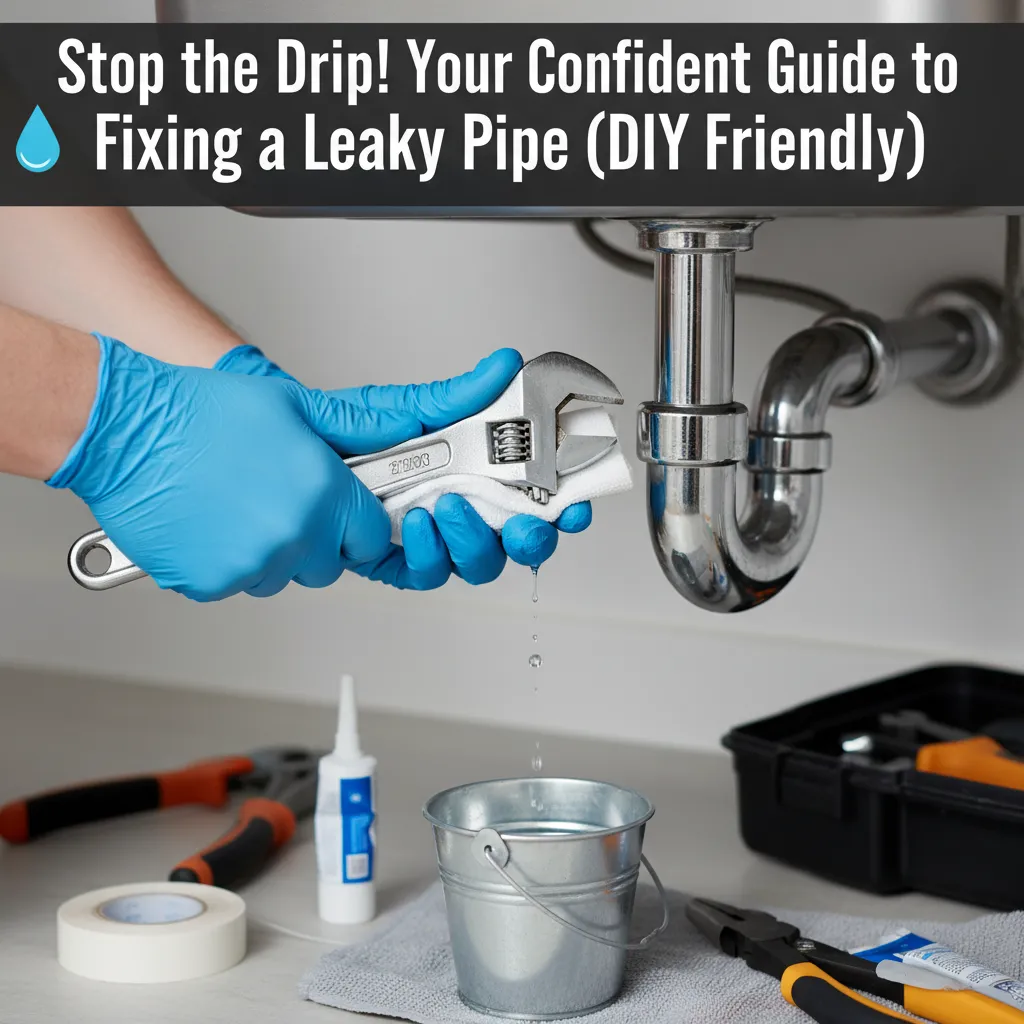
You've found water where it shouldn't be — maybe a steady drip under the kitchen sink, a leaky pipe joint in the basement, or a spray behind the toilet supply line. It feels urgent, messy, and potentially expensive. That frustration and worry are completely normal! Leaks waste water, cause damage, and can feel overwhelming. But understanding why it's leaking (a loose fitting, a worn washer, a tiny pinhole) is the first step to a surprisingly simple fix.
That persistent drip... drip... drip... isn't just annoying, it's water damage waiting to happen, and your wallet is already groaning. Take a deep breath! Whether it's under the sink, behind the washing machine, or along a pipe, fixing many common leaks is well within your reach. This guide will walk you through finding the leak, choosing the right fix, and getting it done safely, turning panic into plumbing pride.
Tools Needed
- Adjustable Wrench (or Pipe Wrench): For gripping and turning nuts. Use a cloth over the jaws to prevent scratches on chrome fittings.
- Slip-Joint Pliers: Useful for compression fittings and smaller nuts.
- Pipe Cutter (for copper) or Hacksaw (universal): For cleanly cutting out damaged pipe sections.
- Sandpaper/Emery Cloth (120-220 grit): To clean and roughen pipe surfaces for better adhesion.
- Rags or Old Towels: Essential for drying the area and containing leaks.
- Bucket: To catch water when disconnecting pipes or draining lines.
- Flashlight/Headlamp: Crucial for seeing clearly in dark spaces.
- Safety Glasses: Protect your eyes from debris and water spray.
- Penetrating Oil: For stubborn nuts that won't budge — spray, wait 15 minutes, then tap gently with a wrench.
Materials Needed
- Epoxy Putty Stick (Like JB Weld WaterWeld): For temporary/semi-permanent fixes on pinholes/cracks.
- Pipe Repair Clamp (Bandage Clamp): For sealing larger cracks/holes temporarily or semi-permanently.
- Pipe Thread Tape (PTFE Tape, 1/2" width, 3.5 mil thickness): For sealing threaded joint leaks. Thicker tape fills irregular threads better.
- Pipe Dope (Thread Sealant Paste): Alternative or addition to tape for threaded joints. Choose a non-hardening type rated for potable water.
- Rubber Gasket/Slip-Joint Washer (Specific Size): For leaks at slip-joint nuts (common under sinks).
- Replacement Compression Washer (Match Size): Beveled type for compression fittings.
- Plumber's Grease: Lubricates washers and O-rings for proper seating.
- Replacement Pipe Section/Fitting (Type & Size Specific): If cutting out damaged section (e.g., 1/2" copper elbow).
- Coupling/Union Fitting (Type & Size Specific): For joining new pipe sections.
Solution (Beginner to Intermediate - 15 mins for temporary fixes; 30 mins - 1.5 hours for permanent repairs)
Step 1: Shut Off the Water! (Non-Negotiable)
Find the shut-off valve closest to the leak (under the sink, behind the toilet, near the appliance). Turn it clockwise (righty-tighty) until it stops. If no local valve, find your main shut-off (usually where the water enters the house — basement, crawlspace, garage) and turn it off. Open a faucet downstream (like the sink) to relieve pressure and confirm water is off.
⚠️ Warning: NEVER attempt any repair on a pressurized pipe. Water pressure can cause serious injury. If you can't locate or operate a shut-off valve, call a professional immediately.
Step 2: Dry & Diagnose: Find the Exact Leak Source
Thoroughly dry the leaking pipe and surrounding area with rags. Carefully feel along the pipe and look closely. Is the leak coming from a threaded connection (where two pipes screw together)? From a compression fitting (a nut squeezing a soft washer)? From a soldered joint (copper pipe with a visible solder ring)? Or is it a hole or crack in the pipe body itself?
Joint-type quick ID: Threaded connections have visible screw threads and are common on galvanized steel, brass, and some flexible supply lines. Compression fittings have a distinct nut that compresses a soft brass or plastic ferrule against the pipe — common under sinks and on shut-off valves. Soldered (sweat) joints have a smooth fillet of solder around copper pipe connections.
Mark the exact leak point with chalk — water can trickle along a pipe before dripping, so the stain on the floor may not line up with the actual source. Chalk won't wash off as you work.
⚠️ Warning: If pipes are near electrical wiring/outlets, be extremely cautious. Avoid touching electrical components with wet hands or tools. If unsure, call a pro.
Step 3: Choose Your Weapon: Pick the Right Repair Method
Based on your diagnosis:
- Threaded Joint Leak: Use PTFE tape or pipe dope (or both for the most reliable seal).
- Compression Fitting Leak: Replace the compression washer or ferrule.
- Slip-Joint Leak (under sink): Replace the rubber gasket or washer.
- Small Hole/Crack in Pipe Body: Use epoxy putty or a pipe repair clamp.
- Large Damage/Corrosion: Cut out the bad section and replace it (requires pipe cutter and fittings).
This guide focuses on the first four options as beginner-friendly. If you're dealing with a pinhole leak, the epoxy or clamp route is quick and effective.
⚠️ Warning: Epoxy and clamps are often temporary or semi-permanent fixes. Plan for a permanent repair (replacement section) if the pipe is significantly corroded.
Step 4: Make the Repair
Go to the section below that matches your leak: under the sink, a threaded or compression joint, a pinhole in copper, or a temporary patch. Each one covers the parts and the exact tightening for that fix.
⚠️ Warning: Turn water on SLOWLY to avoid a pressure surge that could blow apart a temporary fix. Be prepared to turn it off instantly if leaking resumes.
Step 5: Test Your Work (Slowly & Carefully)
Double-check your repair is set or cured. Place rags and a bucket under the repair. Slowly turn the water supply back on (counter-clockwise). Watch the repair site closely for several minutes. Look for any sign of weeping or dripping — check with a dry paper towel for even tiny leaks. If it holds, congratulations! If not, turn water off immediately and reassess. If the leak persists after two attempts, stop and call a pro to avoid causing more damage.
Pro Tips
- Keep a roll of PTFE tape and a tube of epoxy putty in your emergency kit — they solve many small leaks fast.
- For threaded joints, pipe dope plus tape used together creates the most reliable seal (tape first, then dope over it).
- When sanding copper for epoxy or solder, sand until shiny clean metal shows — dirt and oxidation prevent adhesion.
- If a slip-joint nut is overtightened and leaking, loosening it slightly (1/8 turn) can sometimes let the washer reseat and seal.
- Wrap a paper towel around a suspected leak point — even tiny weeps will show up clearly on the dry paper.
- Listen for hissing: A quiet hiss often pinpoints tiny leaks before they're visible under a sink.
- Carry a baggie: When disassembling a joint, put small parts (washers, nuts, screws) in a labeled bag so they don't roll away.
- Morning repairs: Water pressure is lowest early in the morning — less residual water to drain when you open a faucet.
- Tape on jaws: Wrap electrical tape on your wrench jaws to prevent scratches on chrome or brass fittings.
When to Call a Professional
Call a licensed plumber if: The leak is on the main water supply line (high pressure!), the pipe is severely corroded or burst, the leak is behind a wall or ceiling, you have galvanized pipes (brittle with age), the leak is at a soldered joint and you're uncomfortable soldering, you've attempted a fix and it still leaks significantly after two tries, or you simply don't feel confident. Expect $150-$500 depending on location and severity — still cheaper than fixing flood damage from a failed DIY attempt.
Leaking Pipe Under the Sink
Most under-sink leaks come from one of two places. The wide plastic drain pipes are held together by slip-joint nuts, and each nut squeezes a rubber or nylon washer. The narrow supply lines run from the shut-off valves to the faucet, and the valves connect with compression nuts (see the next section).
Thread tape won't stop a slip-joint leak. The washer does the sealing there, not the threads, so the fix is a fresh washer and the right amount of tightening.
For Slip-Joint Washers (Under Sinks):
- Unscrew the slip-joint nut. Remove the old rubber gasket (often flat or beveled).
- Clean surfaces. Insert the exact size replacement washer.
- Reassemble and tighten by hand, then give it 1/4 turn with pliers. If it still weeps, try barely loosening it (1/8 turn) — sometimes the washer needs to reseat.
Leaking Pipe Joint or Compression Nut
Start by working out which kind of joint you have (Step 2). A threaded joint needs fresh sealant. A compression joint needs a new washer or ferrule, and more muscle only makes it worse.
For Tape or Dope (Threaded Joints):
- Clean male threads thoroughly with a rag or emery cloth.
- Wrap PTFE tape clockwise around the male threads 5-6 wraps (stretch slightly as you wrap for better adhesion). Keep the tape clear of the first thread to prevent tape fragments from entering the water supply.
- Alternatively, brush pipe dope evenly over the threads.
- Pro combo: Apply tape first, then pipe dope over it — this creates the most reliable seal, especially on irregular or damaged threads.
- Reassemble the joint and tighten until snug plus 1-2 full turns with a wrench.
- Two-wrench rule: Always use a second wrench to hold the adjacent fitting steady while turning — this prevents twisting and stressing the pipe behind the joint.
⚠️ Warning: When tightening any fitting, use steady pressure. Overtightening can crack fittings or crush pipes, making the leak worse! The rule is "snug plus a nudge," not "muscle man."
For Compression Washers (Compression Fittings):
- Unscrew the compression nut. Remove the old washer (it will be flattened or cracked — don't reuse it).
- Inspect the pipe end for burrs or scratches — smooth with emery cloth if needed.
- Slide the new washer onto the pipe with the beveled side facing the fitting.
- Apply a thin layer of plumber's grease to the washer for smooth seating.
- Reassemble and tighten the nut snug plus 1/4 to 1/2 turn with a wrench. That's all it takes — overtightening a compression nut deforms the washer and causes a new leak.
⚠️ Warning: Compression washers deform permanently when compressed — never reuse an old one. Always install a fresh washer that matches your fitting size exactly.
Pinhole Leak in Copper Pipe
A pinhole is usually corrosion eating through the pipe wall from the inside, so check the pipe around it for green patina or pitting before you patch. Epoxy putty rated for potable water seals a small pinhole quickly.
For Epoxy Putty (Pinholes and Small Cracks):
- Knead the putty stick until the color is uniform (usually 1-2 minutes).
- Dry the pipe surface thoroughly — epoxy won't bond to wet metal.
- Press the putty firmly over the leak, extending 1/2 to 1 inch beyond the leak in all directions.
- Mold it smooth and let it cure fully per the package instructions (typically 15-60 minutes) before turning water on.
Treat epoxy on copper as a bridge, not the end of the job. If the pipe needs a section cut out and a new piece soldered or pressed in, call a plumber. A push-fit coupling is the one permanent fix most homeowners can manage (see the fitting comparison further down).
Temporary Fixes: Tape, Clamps and Epoxy
Tape, clamps and epoxy hold a leak until you can make a proper repair. Skip duct tape, which lets go once it's wet.
The tape that works is self-fusing silicone repair tape. Shut the water off and dry the pipe. Then stretch the tape hard as you wrap, overlapping each turn by half and running a couple of inches past the leak on both sides. It bonds to itself rather than to the pipe, so it suits a weeping drain pipe or a small drip on a supply line. Expect days, not years.
For a split or crack too long for putty or tape, a pipe repair clamp (sometimes sold as a pipe bandage) is the stronger choice.
For Pipe Repair Clamps (Larger Cracks):
- Position the rubber gasket directly over the leak — make sure it fully covers the damaged area.
- Wrap the metal clamp around the gasket.
- Tighten the bolts evenly, alternating sides, until snug and watertight.
None of these patches last forever on corroded pipe. Plan to replace the damaged section, and check the patch every few days until you do.
Why Pipes Leak at Joints, Washers and Pinholes
Leaks happen for several reasons:
- Loose Fittings: Vibration from nearby appliances or initial undertightening lets water seep through threads over time.
- Worn Washers and Gaskets: Rubber degrades and hardens with age, losing its ability to seal. This is the most common cause of compression and slip-joint leaks.
- Thermal Expansion: Hot water makes pipes expand and contract more than cold, which can crack a weak seal. If a joint only leaks when hot water runs, the sealant or washer isn't rated for temperature cycling.
- Mineral Buildup: Corrosion and scale on threads prevent a clean seal.
- Pinholes: Internal corrosion (especially in old galvanized or thin copper) eats through the pipe wall from the inside out.
- Cracks: From freezing (water expands as it freezes!), physical impact, or stress on a rigid pipe that was never properly supported.
- Installation Flaws: Crossed threads, insufficient tape wraps, or overtightening during initial installation can cause leaks that show up months or years later.
Tape vs Pipe Dope, Thread Types and Push-Fit Fittings
Wrenches: Adjustable wrenches are versatile and grip most nuts. Pipe wrenches deliver more torque but can mar surfaces — wrap the jaws with tape or cloth for protection. Channel-locks work as an alternative for smaller fittings.
Cutters: Tubing cutters give clean, square cuts on copper and are worth the $15 investment. Hacksaws work on all materials (use a fine 24-TPI blade) but need care to cut straight.
Tape vs Dope — Which One Wins? Both seal threaded joints, but they serve slightly different purposes. PTFE tape is clean, inexpensive, and ideal for standard straight threads on water lines — it acts as a lubricant during assembly and fills microscopic gaps. Pipe dope (paste) is easier for beginners — no wrapping technique needed — and excels on irregular, damaged, or tapered threads where tape can't fill voids. For high-reliability seals (main shut-off valves, hose bibs, water heater connections), use both: wrap tape first, then brush dope over it. This combo fills gaps that either alone would miss. Choose products rated for potable water, and avoid mixing brands or types within the same joint.
NPT vs BSP Threads — Why It Matters: Not all threaded pipes use the same standard. Most residential plumbing in North America uses NPT (National Pipe Taper) threads, which seal by wedging the tapered male thread against the female port. BSP (British Standard Pipe) threads are common on imported fixtures and some irrigation equipment. They look similar but have different pitch angles (60° for NPT, 55° for BSP) and are not interchangeable — forcing a BSP fitting into an NPT port will crack the fitting. If you're working on an imported faucet or an older home with non-standard fittings, take the old fitting to the hardware store for an exact match.
Push-Fit (SharkBite) vs Sweat vs Press — Which Fitting Is Best? Push-fit connectors (like SharkBite) are the fastest option and ideal for tight spaces where you can't get a torch — they grip with a stainless steel ring and seal with an O-ring, rated for continuous pressure at up to 200 PSI and 200°F in manufacturer testing. Sweat (soldered) copper joints are the traditional standard — cheaper per fitting but require a torch, flux, and skill to avoid pinhole leaks. Press fittings (ProPress, etc.) use a powered tool to crimp the fitting onto the pipe — they're fast and reliable but the tool rental ($100-$200/day) only makes sense for multiple joints. For a homeowner doing one or two repairs, push-fit is the practical choice despite higher per-fitting cost.
Epoxy: Choose a product specifically rated for wet and potable water applications (e.g., JB Weld WaterWeld). It sets underwater if needed, but bonding is strongest on dry pipe.
Clamps: Make sure the rubber gasket is wide enough to cover the damaged area by at least 1/2 on each side.
Washers: Take the old washer to the hardware store for an exact match — washer sizes are not universal, and the wrong size will leak.
Safety Before You Open a Leaking Pipe
- Water Off First: Confirm pressure is gone before touching any fitting. Water at 40-80 PSI can spray across the room if you open a joint under pressure.
- Electrical Hazard: Water plus electricity equals danger. If the leak is near wiring, outlets, or appliances, turn off the relevant circuit breaker before starting.
- Eye Protection: Flying debris, water spray, and dripping rust are common — wear safety glasses.
- Hand Protection: Gloves protect against sharp pipe edges (hidden in shadows under sinks) and chemical sealants.
- Slip Hazard: Keep the floor as dry as possible — a wet basement floor is a fall risk.
- Chemical Safety: Follow epoxy and pipe dope instructions. Use in well-ventilated areas.
- Don't Overtighten: This is the single most common cause of new leaks and cracked fittings. Snug plus a nudge — not brute force.
- Gas Pipes: If you smell gas near any pipe work, evacuate and call the utility company immediately. Never work on gas lines as a DIY project.
Pipe Still Leaking After You Fixed It?
Still leaking after resealing? You may have crossed threads — disassemble and inspect the male threads for damaged or flattened grooves. If the threads are damaged, you'll need to replace the fitting or use a thread repair file.
Nut won't budge? Apply penetrating oil (WD-40 or PB Blaster), wait 15 minutes, then tap the wrench gently with a mallet to break the corrosion bond. Never use a cheater bar (extending the wrench handle) — you'll snap the fitting.
Leak at a shower valve? Valve body leaks often require cartridge or stem replacement — a different repair from pipe joints. If water is leaking from behind the handle trim, the cartridge O-rings are likely worn. Call a pro if you're not comfortable disassembling a valve.
Water still dripping below but the joint looks dry? Water can travel along a horizontal pipe before dripping at the lowest point. Trace the pipe back to find the actual source, and dry the full length to see where the water first appears.
Fix didn't hold? Did you dry the area completely before applying epoxy? Did the PTFE tape unravel (check wrap direction — must be clockwise)? Is the pipe too corroded for a lasting repair? A temporary fix that fails quickly usually means the pipe section needs replacement.
New leak after fixing the old one? Overtightening nearby fittings or disturbing old pipes can cause a weak spot elsewhere to fail. This is especially common with old galvanized steel — the vibration travels through the pipe and breaks a rust-weakened joint downstream.
How to Stop Pipe Leaks Coming Back
- Annual snug check: During spring cleaning, gently tighten accessible joints — 1/8 turn max. If a nut turns freely, it was loose; if it doesn't budge, leave it.
- Know your shut-offs: Label every shut-off valve clearly. Practice turning them on and off once a year so they don't seize up.
- Insulate pipes: Prevent freezing cracks in cold areas (basements, attics, garages, crawlspaces). Foam pipe insulation is cheap and effective.
- Monitor water pressure: Test with a hose-thread pressure gauge ($10 at hardware stores). If pressure is above 80 PSI, install a pressure-reducing valve to protect joints and appliances from stress.
- Avoid hanging things on pipes: The weight stresses joints and can cause slow leaks over time.
- Address corrosion: If you see significant rust (galvanized) or green patina (copper), plan for replacement before it becomes a leak.
- Periodic checks: Briefly peek under sinks and near appliances every few months. Catching a damp spot early turns a $5 fix into a $500 one.
Cost to Fix a Leaky Pipe: DIY vs Plumber
| Fix | Cost |
|---|---|
| DIY temporary (tape, compound, washer) | $5-$25 |
| DIY permanent (pipe section, coupling, fittings) | $10-$50 |
| Tool rental (pipe cutter, press tool) | $15-$200/day |
| Professional repair | $150-$500+ |
| Water damage from ignored leak | $$$$ |
Tool rental can save you on one-off jobs: a tubing cutter rents for $15/day, and a ProPress tool runs $100-$200/day if you're doing multiple press-fit joints. For a single repair, buying a basic tubing cutter ($15) is cheaper than renting.
DIY fixes save hundreds for minor leaks, but know your limits — a failed repair that causes water damage quickly wipes out any savings. If you're unsure about the repair quality, paying a plumber $150 now beats paying $2,000 for wall and floor restoration later.
Problems That Look Like a Leaky Pipe
- Low Water Pressure: Could be caused by a hidden leak reducing flow, or scale buildup narrowing the pipes.
- Sweating Pipes (Condensation): Not a leak — pipe sweat is moisture from humid air condensing on cold pipes. Fix with foam insulation.
- Water Hammer (Banging Pipes): Caused by sudden pressure changes when a valve closes fast. Install air chambers or water hammer arrestors.
- Frozen Pipes: A major cause of cracks and bursts. If you suspect a frozen section, open the faucet and apply gentle heat (hair dryer, not a torch).
- Corroded Pipes: Whole-house repiping (galvanized to copper or PEX) might be needed eventually if multiple joints are failing.
Frequently Asked Questions
Can I just use duct tape to fix a leak?
Absolutely not! Duct tape dissolves when wet and creates a sticky mess. Use epoxy putty or a pipe clamp for a proper temporary fix until you can make a permanent repair.
My pipe is leaking at a joint I just tightened. What did I do wrong?
You likely overtightened it — this can crush the pipe, distort the fitting threads, or shred the washer. Turn the water off, loosen the fitting slightly (1/8 to 1/4 turn), and see if it seals. If not, disassemble, check for damage, clean the threads, and reassemble with fresh tape or dope, tightening only until snug and leak-free.
Why does my joint leak only when hot water runs?
Heat makes pipes expand more than cold water, which breaks weak seals. Reseal the joint with high-temperature PTFE tape (usually pink or gray) rated for hot water lines. If it still leaks, the washing effect of expansion and contraction may have deformed the fitting itself.
How tight is "tight enough"?
For compression fittings: snug plus 1/4 to 1/2 turn with a wrench. For threaded joints: hand-tight plus 1-2 full turns with a wrench. If you hear cracking or feel sudden resistance, stop — you've already overtightened. The goal is "sealed," not "as tight as possible."
Is pipe compound better than Teflon tape?
Both work, but they shine in different situations. Compound is easier for beginners — no wrapping technique needed — and better for irregular, damaged, or tapered threads where tape can't fill voids. Tape is cleaner, cheaper, and preferred for standard drinking water lines. For big gaps, use both: tape first, then compound over it. This combo seals better than either alone.
How long will an epoxy putty or clamp repair last?
It depends on the leak size, pipe condition, water pressure, and product quality. A good repair on a small hole in a stable pipe can last years, but consider it a robust temporary or semi-permanent fix. If the pipe is badly corroded around the leak, the corrosion will spread and the fix will eventually fail. Plan for permanent pipe section replacement when practical.
I see green stuff on my copper pipe. Is that the leak?
The green or blue deposit (patina) is oxidation caused by moisture reacting with copper. It's often a sign that a small weep has been present for a while. Clean the area thoroughly to find the actual pinhole or crack causing it. Significant green patina with pitting means the pipe wall is thinning — that section has a limited lifespan and should be replaced.