
Can an expansion tank reduce water pressure?
Short answer: No. A properly installed water heater expansion tank cannot and will not lower water pressure in your house. The expansion tank's sole purpose is to absorb the increased water volume that occurs when cold water heats up inside your water heater tank. It's a passive safety device required by plumbing code in closed-loop systems. An expansion tank itself does not reduce water pressure; it only absorbs thermal expansion 1.
If you experienced lower water pressure immediately after replacing or installing an expansion tank, the tank itself is not to blame - but the installation process may have caused or revealed other issues.
Understanding How Expansion Tanks Work
Before troubleshooting, it's helpful to understand what an expansion tank actually does. When water heats from cold (around 50°F) to hot (120-140°F), it expands by approximately 2-3% in volume. In modern plumbing systems with pressure reducing valves or check valves, this expanded water has nowhere to go—it can't flow backward into the city water main.
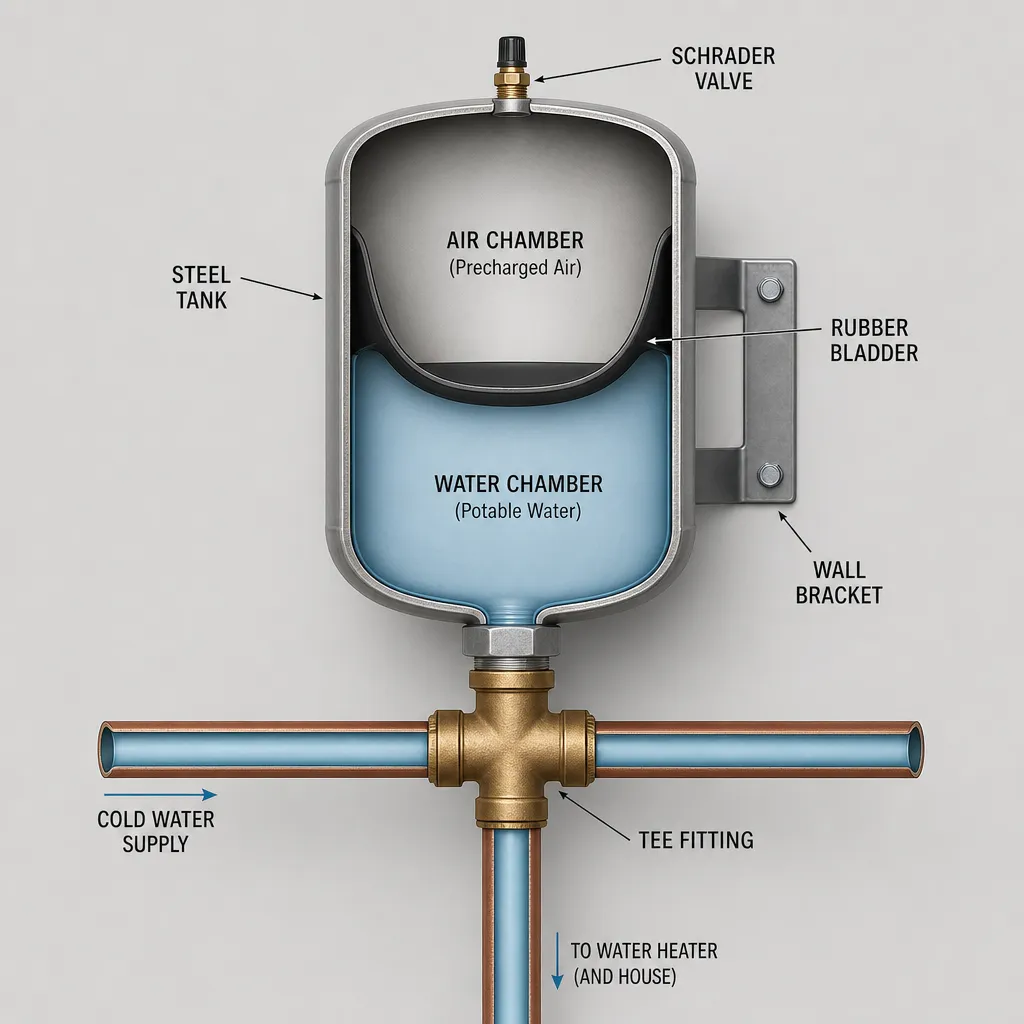
Without an expansion tank, this thermal expansion creates dangerously high pressure that can:
- Cause T&P valve leaks
- Stress pipe joints and fixtures
- Shorten water heater lifespan
- Lead to catastrophic failures
The expansion tank provides a cushion of air (separated by a rubber bladder) that compresses slightly when the hot water expands, maintaining safe system pressure. Because the air inside the tank is compressible and the tank is connected to your plumbing via a standard pipe fitting, it has zero negative impact on water flow or pressure.
For the tank to work properly, it must be pre-charged to match your incoming water pressure, typically between 38 and 80 psi 2. If the air charge is too low or too high, the tank can't absorb the expansion correctly, which can lead to pressure fluctuations or even damage the bladder.
Why You're Experiencing Low Water Pressure
If you're experiencing low pressure after installing an expansion tank, here are the real culprits:
1. Shutoff Valves Not Fully Opened
This is the #1 most common cause. After installation work, the cold water inlet valve or hot water outlet valve on your water heater may not have been fully reopened. Even a quarter-turn closed can dramatically reduce flow. A partially closed shut-off valve can cause a noticeable drop in water pressure after adding an expansion tank 3.
How to check:
- Locate the shutoff valves on top of your water heater (or underneath on newer units)
- Turn them counter-clockwise until they stop - they should be fully open
- Gate valves should be turned all the way open; ball valves should be in line with the pipe
2. Installation Debris or Displaced Gasket
During installation, it's surprisingly easy to:
- Drop a rubber washer or gasket into the pipe
- Leave thread sealant or PTFE tape fragments in the water line
- Dislodge sediment from old pipes
- Accidentally crimp a flexible connector
How to check:
- If only hot water pressure is affected, the blockage is likely in the hot water outlet pipe or expansion tank connection
- Remove the aerators from affected faucets and check for debris
- Check the expansion tank connection - ensure nothing is blocking the tee fitting
3. Undersized or Incorrect Pipe Fittings
If a DIY installer used smaller diameter fittings than the existing plumbing (for example, installing a ½" tee where ¾" pipe exists), this creates a bottleneck that restricts flow. Undersized piping can cause a noticeable drop in water pressure after adding an expansion tank 3.
How to check:
- Visually inspect all new fittings installed with the expansion tank
- Ensure the expansion tank connection tee matches the diameter of your cold water inlet pipe (usually ¾")
- Verify that flexible connectors aren't kinked or compressed
4. Hot Water vs. Cold Water Pressure Difference
A minor difference in pressure between hot and cold water is normal and often goes unnoticed until you're paying attention after installation work. Hot water typically has slightly lower pressure due to:
- Longer pipe runs from water heater to fixtures
- Additional fittings and valves in the hot water system
- Potential sediment buildup in hot water lines
What's normal:
- A barely noticeable difference is fine
- If cold water feels significantly stronger, you have a hot water system issue unrelated to the expansion tank
Diagnosing Whole-House Pressure Issues
If both hot and cold water pressure dropped throughout the house, the issue is more serious and unrelated to the expansion tank. When you turn on a faucet, you'll see a small pressure drop—that's normal. But if the drop is large, it points to a partially closed valve or an obstruction somewhere in the line 4.
1. Clogged Main Water Line
Sediment, mineral buildup, or debris can partially block your main water supply line. This is more common in older homes with galvanized steel pipes.
Signs:
- Gradual pressure loss over weeks/months
- Discolored water (rust or sediment)
- Pressure loss worsens over time
Solution:
- Professional pipe inspection and cleaning
- Consider whole-house water filtration
- May require pipe replacement in severe cases
2. Damaged Main Water Line
A leak in your main water line (between the street connection and your house) diverts water underground instead of to your fixtures.
Signs:
- Sudden pressure drop
- Unexplained high water bills
- Soggy areas in your yard
- Running water sound when all fixtures are off
Solution:
- Contact a licensed plumber immediately - this is urgent
- May require excavation and pipe repair/replacement
3. Municipal Water Supply Issues
Sometimes the problem is outside your control - the city water main may have reduced pressure due to maintenance, breaks, or increased demand.
How to check:
- Ask neighbors if they're experiencing the same issue
- Contact your local water utility to report low pressure
- Check your utility's website or social media for service announcements
4. Frozen Pipes
If you just completed expansion tank installation during cold weather and the water heater was shut down for an extended period, pipes may have partially frozen.
Signs:
- Very cold weather (below 32°F) during or before installation
- Pressure gradually returns as temperature rises
- Only affects certain fixtures or zones
Solution:
- Gently warm affected pipes with a space heater or hair dryer (never use open flame)
- Open faucets to relieve pressure
- Insulate vulnerable pipes to prevent future freezing
Expansion Tank-Specific Troubleshooting
While the tank itself doesn't cause low pressure, installation-related issues can. Here's how to check the tank and its connection.
Check the Expansion Tank Connection
- Verify the tank is connected to the cold water inlet side (not hot water outlet).
- Ensure the isolation valve (if present) is fully open.
- Check that the tee fitting isn't blocked — remove and inspect if necessary.
- Confirm the expansion tank is properly pressurized. It should have 2–4 PSI less than your home's water pressure (typically set to 50–60 PSI for a 60–75 PSI system).
Test the Expansion Tank
A waterlogged or failed expansion tank won't cause low pressure, but it defeats the purpose of having one. Here's how to tell if yours has gone bad:
- Tap the tank with a tool like a screwdriver handle. A hollow sound means air is present; a dull thud means the tank is waterlogged 5.
- Press the valve stem on top of the tank (like a tire valve). If water comes out instead of air, the internal bladder has failed.
- Use a tire pressure gauge on the Schrader valve to check the tank's pre-charge pressure against your home's water pressure 6.
If the tank is waterlogged or the bladder has failed, replace it.
Step-by-Step Pressure Restoration
Follow these steps in order:
- Turn all shutoff valves fully open - water heater inlet/outlet, under-sink valves
- Remove and clean faucet aerators - check for installation debris
- Check your pressure reducing valve (PRV) - if your home has one near the main shutoff, ensure it's set correctly (usually 50-75 PSI). After installing an expansion tank, check static pressure at a gauge after the PRV; it should not exceed 70 psi and should not climb after water is turned off 4. A water heater with a bad expansion tank can cause pressures to rise, as can a leaky PRV 7.
- Flush your water heater - installation may have stirred up sediment
- Inspect all new fittings - ensure nothing is kinked, crimped, or undersized
- Test at different fixtures - isolate whether it's a whole-house or localized issue
When to Call a Professional
Sometimes you've checked everything you can reach and the pressure still isn't right—that's when it's time to bring in a pro. Call a licensed plumber if:
- You can't identify the cause after checking valves and aerators
- Both hot and cold pressure are severely reduced throughout the house
- You suspect a main line leak (soggy yard, high bills)
- Pressure doesn't improve after troubleshooting
- You find a waterlogged expansion tank that needs replacement
Professional diagnostics may include:
- Pressure testing your plumbing system
- Camera inspection of pipes
- Main line leak detection
- PRV adjustment or replacement
One thing you should never have to fix yourself: an expansion tank that's hanging off the piping without its own support. Code requires the tank to be supported independently—not by the pipes connected to it—to avoid stress on the connections 8. If yours is just dangling, call a plumber to add proper strapping or a bracket before a joint gives way.
Related Issues
Low water pressure can sometimes coincide with other problems:
- Water heater not heating properly - sediment may be affecting both pressure and heating
- Leaking T&P valve - might indicate thermal expansion issues the new tank should prevent
- Noisy pipes (water hammer) - could signal pressure fluctuations or water heater expansion tank issues
Prevention Tips
A little routine attention keeps your pressure steady and your expansion tank doing its job. You don't need to be a pro — just build a few simple habits.
Always fully reopen valves after any maintenance. A partially closed valve is one of the most common causes of mysterious pressure drops, and it's an easy one to miss.
Clean aerators every 6 months. Mineral buildup sneaks up on you, gradually choking flow until you're standing at the sink wondering why the pressure's so weak.
Schedule annual water heater maintenance, including a good flush to remove sediment. Sediment doesn't just hurt efficiency — it can clog lines and mess with your pressure over time.
Consider installing a water pressure gauge on a hose bib. Knowing your baseline pressure makes it way easier to spot a problem before it becomes a headache.
Insulate pipes in cold areas to prevent freezing during cold snaps. A frozen pipe isn't just a pressure problem — it's a burst-pipe disaster waiting to happen.
Expansion tanks don't last forever. Plan on replacing yours about every 7 years 9. If you're installing a new one, mount it with the water connection pointing up for best performance. If you have to mount it horizontally or upside down, make sure the tank body is fully and rigidly supported to handle the weight when it's full of water 10.
Bottom Line: The Tank Isn't the Culprit
An expansion tank is a critical safety device required by modern plumbing standards, but it absolutely cannot cause low water pressure when it's installed correctly. If you're seeing reduced pressure after installation, focus your troubleshooting on shutoff valves, installation debris, fitting sizes, and other plumbing system issues. In most cases, the fix is simple—a valve that needs opening or an aerator that needs cleaning.
Remember: the expansion tank is protecting your water heater and plumbing system from dangerous thermal expansion pressure. Don't remove it to "fix" a pressure problem that it's not causing!