
Spray head sprinklers look simple. Then you end up with brown stripes on one side of your lawn and waterlogged roots on the other. Getting the choice right depends on four variables: the size of the zone, the plants in it, your water pressure, and how the head mounts to the ground. Mismatch any one and you waste water, damage plants, and shorten equipment life. This guide walks through each one. It opens with an interactive tool that narrows the field to a specific product in under a minute.
Find Your Spray Head — Interactive Tool
Answer four quick questions and the tool will give you a specific product recommendation matched to your situation.
1. Coverage Area Determines the Head Type
Coverage area is the single biggest factor in choosing between spray heads and rotor heads. It's also the one most homeowners get wrong. The rule of thumb: fixed spray heads work best in zones up to about 100 m². Individual heads cover a radius of 1.5 m to 5 m, depending on the nozzle. Anything larger and you're into rotor territory — the tool above flags this if your area qualifies.
Total zone area also sets body size. A 4-inch pop-up — the Rain Bird 1804 or Hunter PS-04 — is the right call for small beds and compact lawns under roughly 25 m². A 6-inch pop-up (Rain Bird 1806, Hunter PROS-06) handles larger zones. It's also the better pick where tall grass or built-up mulch might block a shorter head.
Getting coverage area wrong creates two failure modes. First, under-coverage: too few heads, or too short a radius, leaves dry spots in the gaps between arcs. Second, over-coverage: too many heads on one zone overwhelms the supply line. Operating pressure drops, and every head produces a weak, uneven pattern.
The practical rule: plan for head-to-head coverage, where each head reaches the next. And use the manufacturer's rated radius at your actual operating pressure — not the maximum figure printed on the packaging. A head rated for 4.5 m at 30 PSI tells you little about your zone. At the 20 PSI you actually have at the far end, it may reach only 3.7 m.
To check whether your layout will water evenly, calculate the gross precipitation rate. For a full-circle sprinkler on square spacing, the formula is (96.3 × flow in GPM) / area in square feet 1. That number tells you how fast water lands. Match it across head types and you avoid over- or under-watering.
2. Spray Patterns and Arc Options
Every spray head nozzle produces a fixed arc — the angle of the fan of water it throws. Standard arcs are sold in set increments, with adjustable-arc nozzles available for irregular shapes:
| Arc | Common name | Typical use |
|---|---|---|
| 360° | Full circle | Island beds, centre of an open lawn |
| 270° | Three-quarter | Corner areas with one open side |
| 180° | Half circle | Along a straight edge — fence, path, or wall |
| 90° | Quarter circle | True corners of a rectangular zone |
| 0°–360° | Adjustable arc | Irregular shapes, asymmetric layouts |
| — | Side / end strip | Narrow bands under 1.5 m wide |
Matched Precipitation Rate (MPR) nozzles are the standard choice for most residential lawns. MPR means every nozzle delivers the same volume of water per square metre per hour — whether it's a 90° quarter-circle or a 360° full circle. That matters more than it sounds. Mix standard non-MPR nozzles of different arcs on one zone, and the quarter-circle areas get up to four times more water than the full-circle areas. The result is wet corners and a dry centre — a fault many homeowners wrongly blame on their controller. MPR nozzles let you mix arcs and radii on the same circuit without that problem. That simplifies the design and keeps the lawn evenly green 2.
MP Rotator nozzles (Hunter) and similar rotating-stream formats apply water far more slowly than fixed spray — roughly 10–15 mm per hour, versus 40–50 mm per hour for standard spray. That slower rate makes them excellent for slopes, clay soils, or anywhere water runs off before it can soak in. Hunter's MP Rotator range covers trajectories from 14° to 26° and radii from 12 to 79 feet at 40 psi. That's precise control for tight spots and large lawns alike 3.
3. Water Pressure: The Factor Most People Ignore
Water pressure decides whether a spray head throws a clean, even pattern or a misty fog that drifts off before it reaches the soil. Most residential spray heads are rated for 15–30 PSI (1.0–2.1 bar). That's measured at the head itself — not at the backflow preventer, the meter, or the tap. Pressure drops along every metre of pipe and through every fitting. So the figure at the source is almost always higher than what the head actually sees.
Too low (under 15 PSI): The nozzle pattern collapses. You'll see a donut-shaped ring of water instead of even coverage, with a dry centre directly under the head. No amount of extra run time fixes this — the arc simply doesn't form correctly at low pressure.
Too high (over 30 PSI): The spray atomises into fine mist. Wind carries the droplets off target, and much of the water evaporates before it reaches the soil. Heads also wear faster under high pressure, and nozzle seals fail early. Experienced plumbers point out that 80 psi is well above the design of most spray heads. Regulation cuts the misting and lifts overall system efficiency 4.
Neither problem is solved by adjusting controller run times. The hardware fix is a pressure-regulating spray head body. Rain Bird's SAM-PRS series and Hunter's PRS40 each have a built-in regulator. It caps delivery pressure at a fixed value, whatever arrives from the main line. One nuance matters here: a regulated body needs a pressure differential of at least 10 psi to fully open. A PRS40, for example, needs 50 psi in use — not static — to work correctly 4.
Before buying anything, measure your static pressure with an inexpensive gauge on an outdoor tap. Then estimate pressure loss from your pipe length, diameter, and fitting count. That number tells you which head and nozzle combination will actually perform at your site. And this is no longer just a nice-to-have: PRS pop-ups are now mandated in 8 states, with more expected to follow 5.
4. Pop-Up vs. Shrub-Mount Heads
Pop-up heads sit flush with the soil when the zone is off. During the cycle, the stem rises under water pressure, delivers the spray pattern, then drops back down when the zone shuts off. Retracting shields the nozzle from mowers, foot traffic, and UV degradation. That makes pop-ups the default for any area with regular foot or equipment traffic. Standard heights are 2-inch, 4-inch, 6-inch, and 12-inch. Pick a height that clears the grass or ground cover at its peak seasonal growth. A 2-inch head under a thick kikuyu lawn barely clears the turf; a 6-inch head in a low ground-cover bed is needlessly tall.
Shrub-mount heads are fixed in place, on a riser or stake above the soil. They're the better choice for dense shrub beds, where the head must project above the plant canopy. They also help where digging in a flush-mount body would disturb established roots, or on steep slopes where carving a level pocket for a pop-up is impractical. The trade-off is exposure: a shrub-mount head sits permanently above ground, vulnerable to garden tools, vehicles, and animals.
For most residential applications, pop-up heads win on convenience and longevity. Shrub-mounts are the right call when clearance or access makes pop-ups impractical.
5. Trusted Brands and What to Buy
Two brands dominate the residential and light-commercial spray head market. Both are genuinely professional-grade, sold through irrigation supply houses and many plumbing merchants.
Rain Bird is the most widely distributed brand globally. Take the 1800 Series: the number after "18" is the pop-up height in inches, so a 1804 is a 4-inch pop-up. It has been the backbone of countless residential systems for four decades. Rain Bird's PRS-SAM spray heads add two things — pressure regulation, plus a sealing gasket that stops flow when the head retracts. That gasket prevents low-head drainage on slopes 6. The nozzle families include MPR for standard turf, U-series for smaller areas, and LPS for low-pressure sites.
Hunter Industries is Rain Bird's closest competitor on performance and reputation. Its Pro-Spray and PROS series match Rain Bird's body options feature for feature. Hunter's PRS30 stem regulates pressure only — it has no anti-drain gasket like the one in Rain Bird's PRS-SAM 6. The MP Rotator nozzle, a rotating-stream format Hunter pioneered, is one of the best-selling irrigation nozzles worldwide. For 15–30 ft throws with at least 40 psi at the head, MP Rotators are a durable alternative to mini rotors. Mini rotors tend to break 7.
For budget DIY installs, Orbit (Eclipse and B-hyve series) costs noticeably less and is widely stocked at big-box stores. Nozzle range and pressure performance are more limited, but Orbit heads are a reasonable pick for straightforward, low-stakes zones.
Many contractors prefer Hunter valves for one practical reason: a dual-screw design (Phillips and hex) that resists stripping. Rain Bird valve screws, by contrast, strip easily 8.
Head-to-Head Spacing: The Most Misunderstood Rule
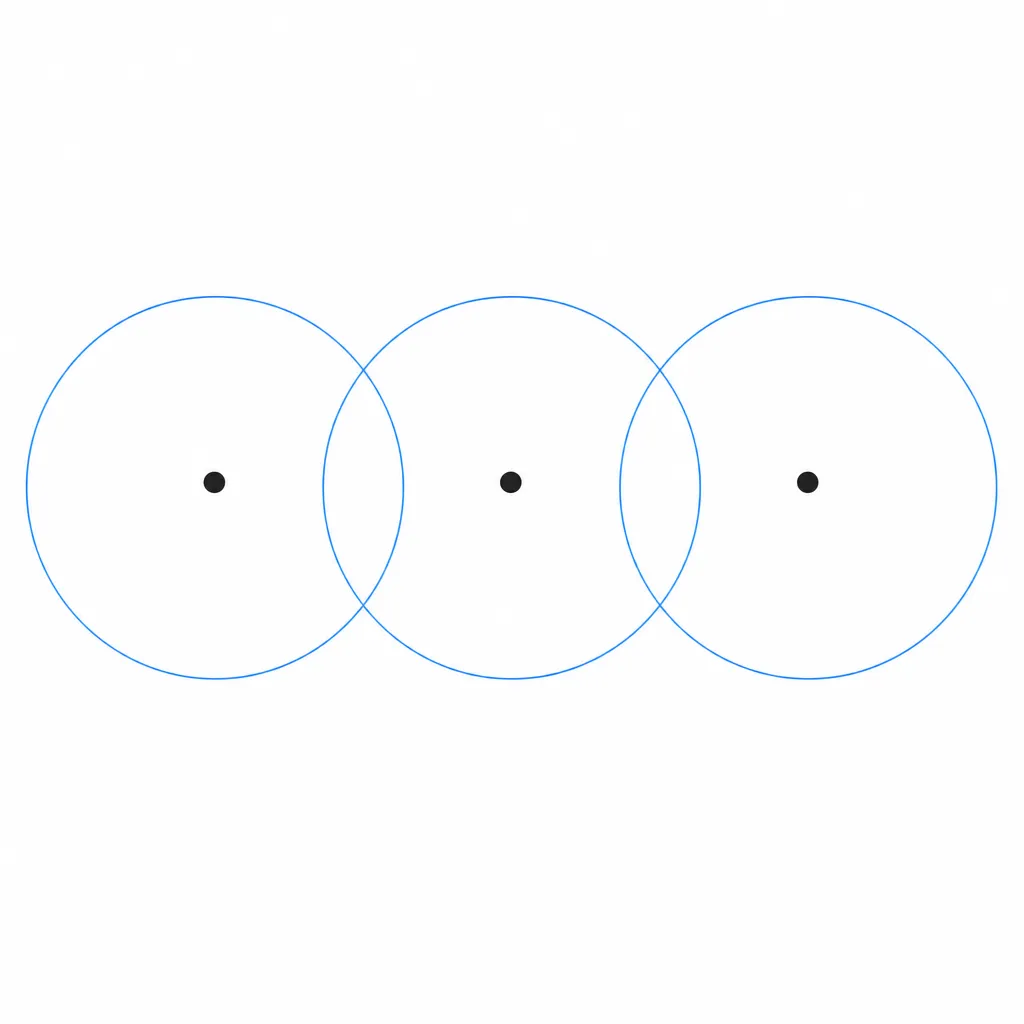
Head-to-head coverage means the radius of each spray head equals the distance to its nearest neighbour. If a nozzle is rated for a 3 m radius, heads are placed 3 m apart in every direction. The outer edge of each arc reaches exactly to the body of the next head.
This sounds like wasteful overlap, but it corrects for a real physical effect. Nozzle patterns lose a lot of water volume at their outer edge, thanks to natural precipitation falloff and wind drift. Without head-to-head coverage, the mid-span gaps get roughly 30–40% less water than the areas near a head. That's the distinctive striped dry pattern — the one most homeowners wrongly blame on a faulty valve or a bad controller setting.
The rule also kills a tempting shortcut. You can't just buy a nozzle rated for the longest radius, space the heads further apart, and save on head count. The rated radius is a maximum, hit only at the specified operating pressure. Drop 5 PSI below spec and the radius can shrink 15–20%, turning a good layout into an under-covered one. Rain Bird MPR nozzles, for example, have an operating range of 15 to 30 psi and spacing from 3 to 15 feet (0.9 to 4.6 m) 9. Below that range, the real radius falls short of the label claim.
To nail the spacing, match the nozzle's precipitation rate across adjacent heads. A Hunter Pro Adjustable nozzle set to 180° at 30 psi delivers 1.26 GPM, a precipitation rate of 1.68 in/hr 10. Pair it with a quarter-circle head on the same zone, and that head must apply water at the same rate per square foot. Otherwise you get soggy spots beside dry ones. Always check spacing against the manufacturer's performance tables at your real operating pressure — not the label maximum — before you dig. Getting spacing right on paper costs nothing. Digging up a finished install to add missing heads costs far more.
Plan First, Then Buy the Hardware
Selecting the right spray head means working through four things in order: coverage area, landscape type, water pressure, and mounting style. That's exactly what the decision tool at the top of this page does for you. Once you've settled on the head and nozzle, installation is straightforward. The real work is in the planning. Measure your zones carefully, check operating pressure at the valve, and lay out head positions for head-to-head coverage before you break ground. Get those fundamentals right, and the hardware almost picks itself.